

Cristiana-Ștefania Culiță, museographer
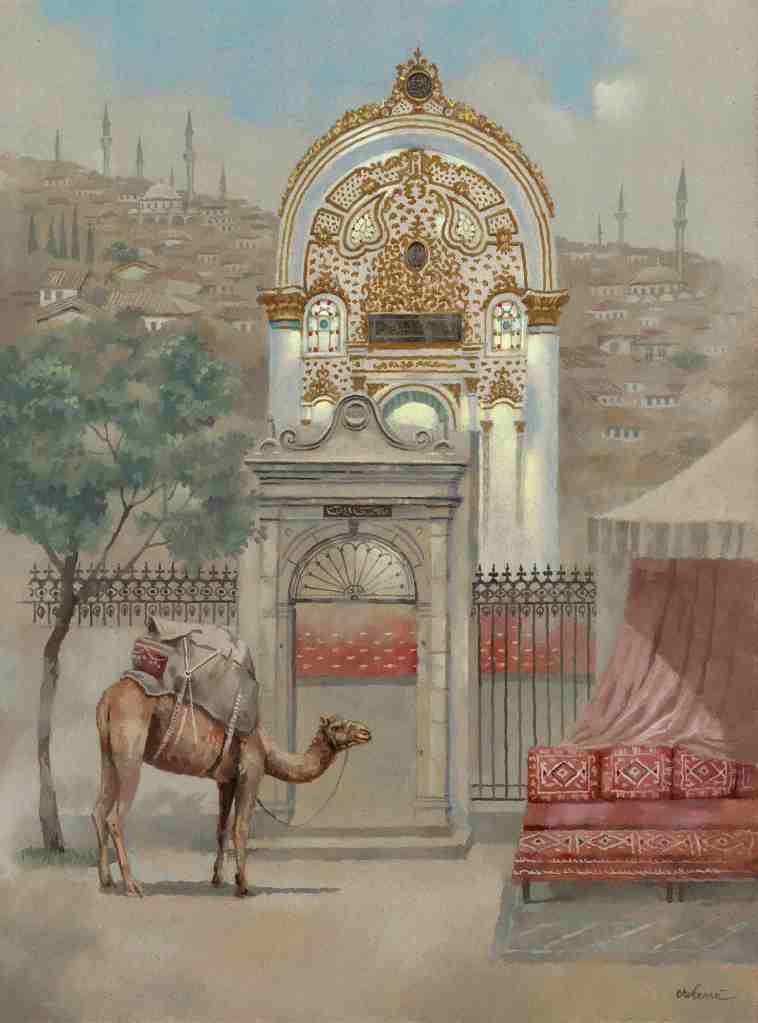
1. 𝐻𝑖𝑠𝑎𝑟 𝐶𝑎𝑚𝑖𝑖
Izmir Series
40 × 30 cm, oil on cardboard, 2026
The new series dedicated to the city of Izmir continues artist Florian Doru Crihană’s ongoing exploration of urban environments, revealing their layered historical identities. The first work in the series focuses on the Hisar Mosque, drawing on a set of historical and visual references that the artist reorganizes into a unified image: the mosque built at the end of the 16th century, its relationship with the Kemeraltı Bazaar, and the role of the mihrab in orienting sacred space.
In “Hisar Camii,” the mosque’s gate becomes the central axis of the composition. The ornamental arch and the golden decoration of the mihrab niche are extracted from the interior of the building and brought to the exterior. This displacement alters the logic of real space: the mihrab, traditionally intended to guide prayer, now appears as a visual portal marking the threshold between the everyday life of the city and the symbolic territory of the image.
Around this central structure, Crihană introduces elements of urban life: the camel (documented in historical photographs of the old bazaar) and the ornamental carpet (evoking the commercial world of Kemeraltı and the decorative traditions associated with Islamic space). The background adds another layer through the silhouettes of mosques and minarets fading into the urban landscape. The work functions as an imagined reconstruction of a fragment of Izmir, where the city is condensed into a constellation of signs evoking architecture, commerce, and the sacred dimension of place.
This first work establishes the method the artist will continue in subsequent images: starting from the city’s visual elements and historical documents, and reorganizing them into scenes where historical reality and imaginative construction coexist.
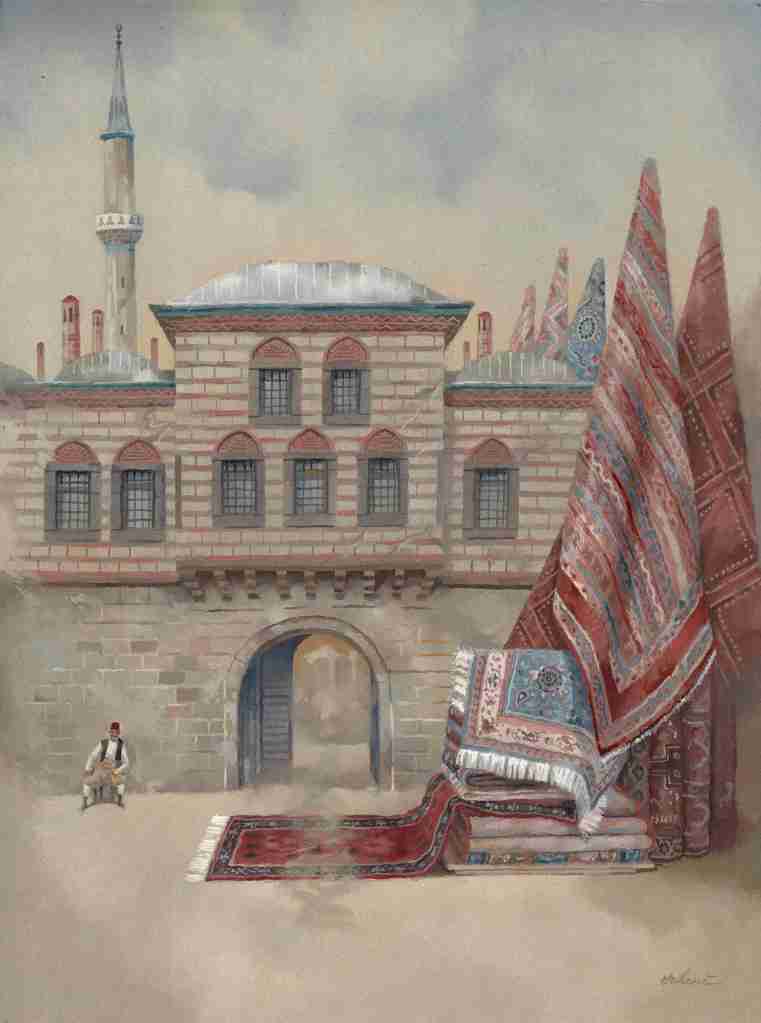
2. 𝐾ızlarağası Hanı
Izmir Series
40 × 30 cm, oil on cardboard, 2026
In “Kızlarağası Hanı,” the composition is structured around a clear relationship between the architectural framework and the intervention of decorative objects. The façade of the caravanserai—an inn designed for merchants and caravans—and the compact volume of the building establish a recognizable setting grounded in documented reality. The intervention emerges through an ensemble of carpets, traditional textiles used both as everyday objects and as goods of exchange. Removed from the logic of commercial display and rearranged, layered, and elevated into near-vertical forms, they create a visual mass that dominates the image.
The function of this carpet ensemble is explicit: a sign of hospitality, analogous to the red carpet in state protocol. While a carpet laid on the ground indicates a path of access, the vertical structure amplifies this idea, becoming a kind of symbolic portal. Access is thus ritualized, and entering the han becomes an act staged by Crihană.
Hospitality—essential to the very logic of the han—is fully realized by the artist in the atmosphere of the composition, revealing itself to the viewer through subtle elements.
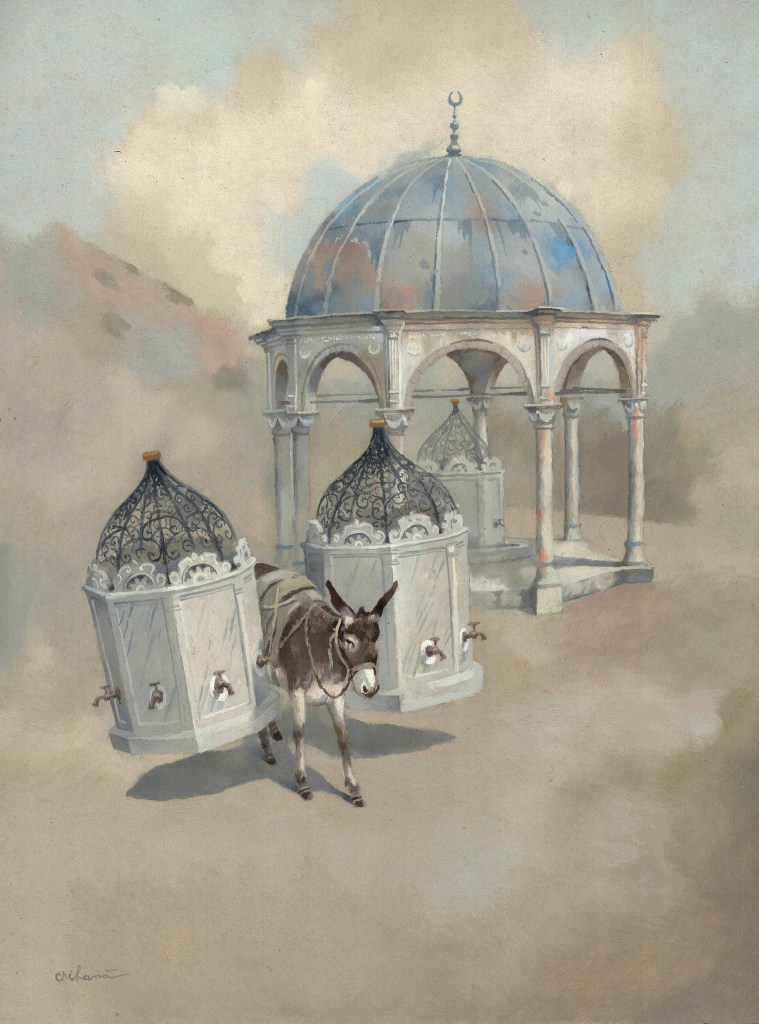
3. 𝐻𝑎𝑐ı 𝑆𝑎𝑙𝑖ℎ 𝑃𝑎𝑠̧𝑎 𝑆̧𝑎𝑑ı𝑟𝑣𝑎𝑛ı
Izmir Series
40 × 30 cm, oil on cardboard, 2026
The fountain of Hacı Salih Paşa in the Kemeraltı Bazaar serves as the starting point for the third work in the series dedicated to Izmir. In historical images, this space appears crowded with people, animals, and vehicles, whereas Crihană’s composition almost entirely eliminates this dynamic. The fountain, with its octagonal structure, is reduced to a clear and easily identifiable form. In the foreground, the donkey carrying two containers becomes the primary element, displaced from its utilitarian role of transport and reconfigured into a balanced relationship with the architectural structure. The two lateral volumes, fragments of the installation in the background, function here as a formal counterpoint.
The fountain’s original function—as a source of water and a meeting place—shifts its emphasis toward the relationship between human, animal, and infrastructure. The presence of the donkey introduces into the composition a register connected to the invisible infrastructure of the old city, which appears in documentation as a constant feature of the marketplace. In Crihană’s painting, the animal is detached from the flow of activity and placed within an almost empty setting. By isolating this figure, the artist redirects attention to the image of elementary mechanisms. The donkey appears as an intermediary between fixed architecture and human activity, but above all in relation to the circulation of resources, becoming an indication of an economy reduced to its essence.
4. 𝑉𝑎𝑙𝑖𝑙𝑖𝑘 𝐵𝑖𝑛𝑎𝑠𝑖
𝐈𝐳𝐦𝐢𝐫 Series
30𝑥40 𝑐𝑚, oil on cardboard, 2026
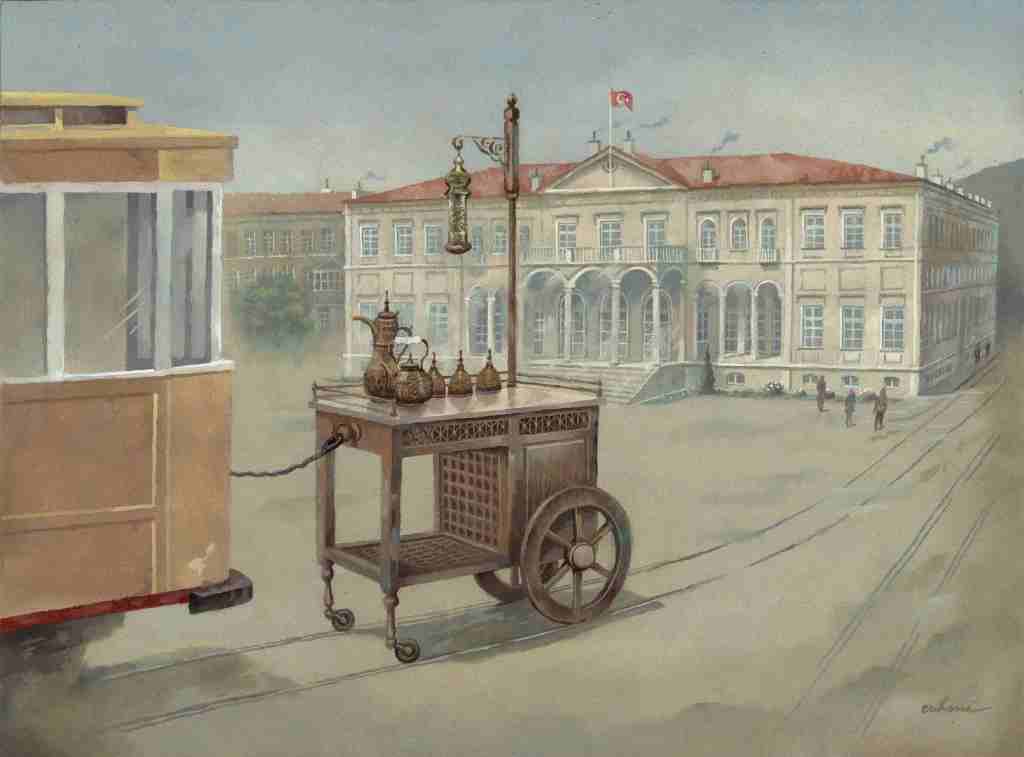
The Governor’s Office Building, placed within its recognizable urban setting—defined by the open square overlooking the Gulf of İzmir and the surrounding landmarks—forms the core of Crihană’s fourth stop in his series dedicated to the city. The composition is structured around two complementary elements: the architectural landmark itself and the infrastructure that introduces movement into the scene.Suggested through the curve of the tram tracks and the tramcar positioned in the foreground, the railway line guides the viewer’s gaze while articulating the surrounding space. This is not a random choice: historically, the tram completed a turning loop around the city’s central square. The composition’s key element, however, is the coffee cart. Removed from its everyday function, it becomes the visual link between architecture and urban space. Associated with the ritual of hospitality and civic protocol, the artist isolates it within the composition, transforming a utilitarian object into a symbolic marker of encounter. Crihană further simplifies the setting by omitting the public garden visible in historical photographs, concentrating attention on the relationship between the building and the urban infrastructure. Freed from vegetation, the square becomes an open stage upon which the essential elements of the composition can interact.
The administrative building, the transport infrastructure, and the ceremonial object are held in a delicate balance that suspends their original functions. The tram line becomes the framework for an improbable scene in which the everyday gesture of serving coffee unfolds within the rhythm of the city—a brief pause along a journey that seems destined to continue.
5 𝐴𝑠𝑎𝑛𝑠𝑜̈𝑟
𝐒𝐞𝐫𝐢𝐚 𝐈𝐳𝐦𝐢𝐫
40𝑥30 𝑐𝑚, 𝑢𝑙𝑒𝑖 𝑝𝑒 𝑐𝑎𝑟𝑡𝑜𝑛, 2026
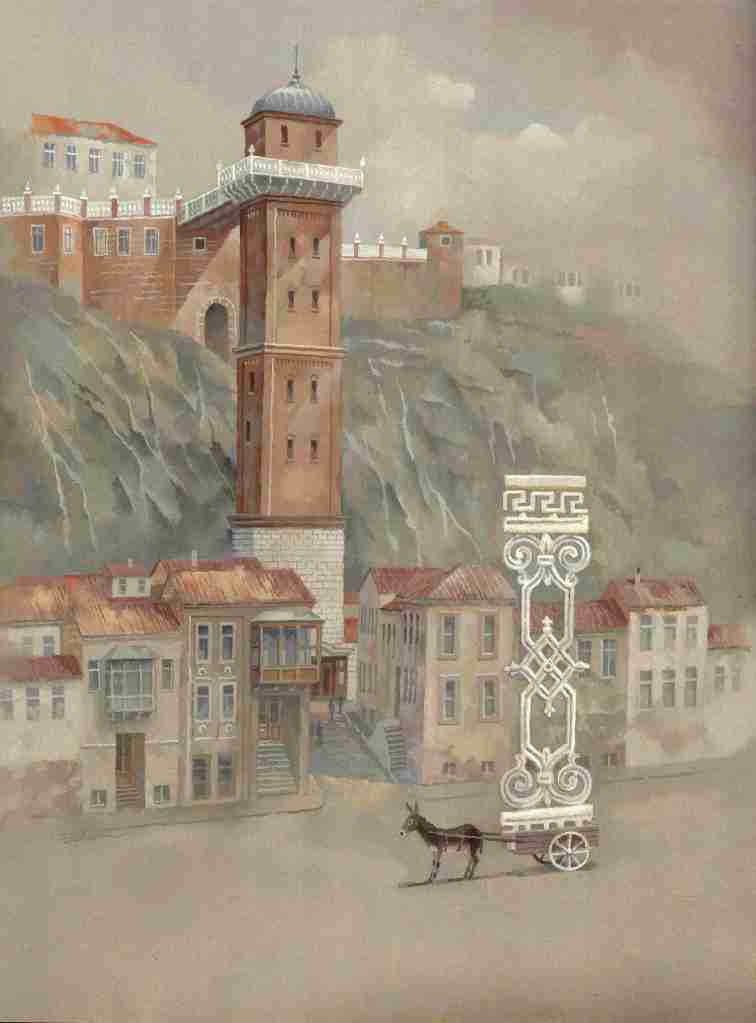
Crihană begins with the vertical structure of the Asansör in the Karataş district, originally conceived as a practical connection between two parts of the neighborhood separated by a steep change in elevation. Built at the beginning of the twentieth century and inspired by the Western model of the elevator, the structure introduced a technical infrastructure with a clearly functional purpose into the urban landscape. Its vertical axis dominates the visual field, organizing the relationship between the different spatial planes. The composition is shaped by the city’s steep topography: buildings are arranged in terraces, following the slope through compact volumes and simple façades, where architectural features such as bay windows and exterior staircases reveal their adaptation to the terrain. This organization creates a clear stratification: the lower level, associated with everyday circulation; the intermediate level, dominated by the mechanism of the elevator; and the upper level, opening toward the distant horizon. The artist’s intervention appears through the introduction of an ornamental element placed in the foreground. Detached from the visual vocabulary of railings and architectural details, this decorative structure becomes an autonomous object within the composition. The presence of the donkey introduces another register, one connected to the city’s elementary infrastructure. As a traditional means of transport, it evokes the everyday movement of goods through the urban landscape.
Crihană places two different forms of infrastructure in dialogue: one technical, defined by efficiency and verticality, and the other elementary, based on mobility. Between them, the ornamental object functions as an intermediary, establishing the visual balance of the composition.
6. 𝑇ℎ𝑒 𝑃𝑜𝑟𝑡 𝑅𝑒𝑠𝑖𝑑𝑒𝑛𝑐𝑒
𝐒𝐞𝐫𝐢𝐚 𝐈𝐳𝐦𝐢𝐫
40𝑥30 𝑐𝑚, 𝑢𝑙𝑒𝑖 𝑝𝑒 𝑐𝑎𝑟𝑡𝑜𝑛, 2026
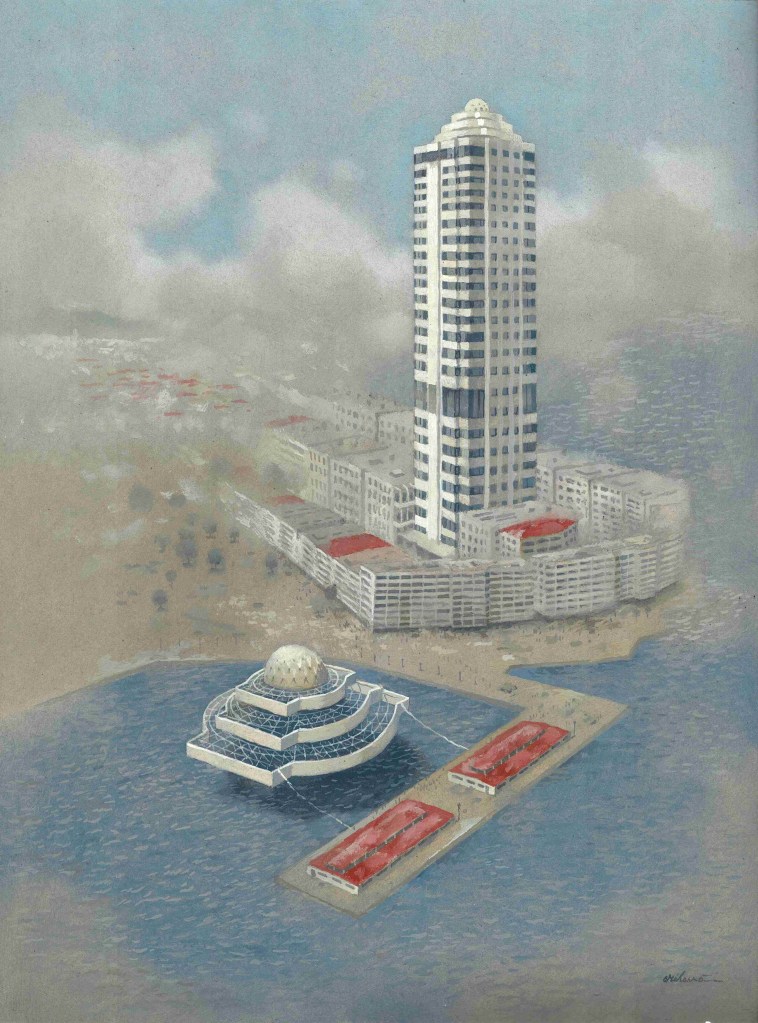
With The Port Residence, Crihană deliberately redirects the course of his series dedicated to İzmir. After a succession of works centered on the caravanserai, the coffeehouse, and other elements of the city’s traditional fabric, the artist turns his attention toward the contemporary image of the metropolis, intentionally suspending its direct connection to the past. Situated near the historic waterfront, the building dominates the Kordon district, where the old city meets recent urban development. Crihană is particularly drawn to the circular structure placed on the roof, a detail he isolates from its architectural context and transforms into a second focal point of the composition. Lowered into the waters of the gulf, the structure acquires an autonomous presence. The tower’s verticality and the concentrated geometry of the pavilion are brought into visual balance through the pier, while the surrounding city is reduced to its essential volumes.
Where the preceding works constructed İzmir’s identity through everyday objects and urban practices, architecture now becomes the language of the present. The gulf itself becomes a silent witness to the city’s transformation, revealing an İzmir that builds its contemporary identity upon the enduring structures of its past. Although the city is in constant transformation, one relationship remains unchanged: the enduring dialogue between land and sea.
7. 𝑇ℎ𝑒 Folkart Towers
𝐒𝐞𝐫𝐢𝐚 𝐈𝐳𝐦𝐢𝐫
40𝑥30 𝑐𝑚, 𝑢𝑙𝑒𝑖 𝑝𝑒 𝑐𝑎𝑟𝑡𝑜𝑛, 2026
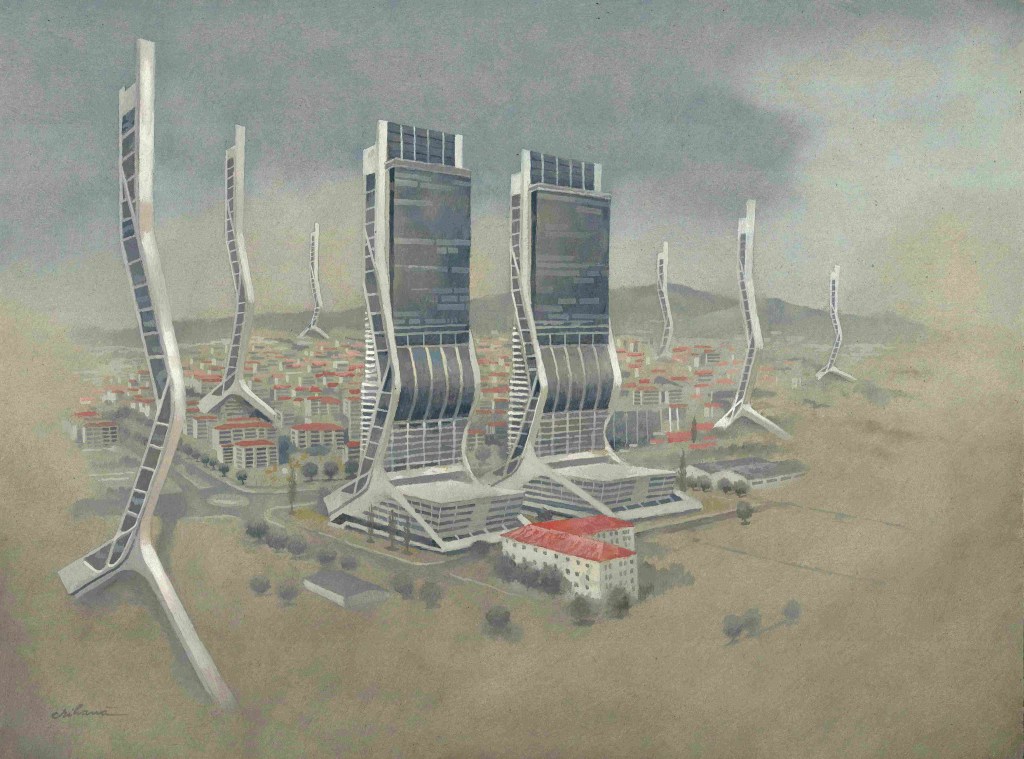
The Folkart Towers occupy a distinctive place within Crihană’s series dedicated to İzmir through the way contemporary architecture becomes the raw material of the artist’s imagination. The twin towers in the Bayraklı district, recognized for their undulating profile, serve as the starting point of this new composition. Crihană isolates their lateral contour, identifying it as the defining element of the buildings. Detached from the architectural structure and repeated throughout the city, this motif no longer belongs to architecture alone. This act of separation marks a significant shift in the composition: the isolated form begins to organize the entire image. Its repetition establishes a system of vertical landmarks that guides the viewer’s gaze toward the horizon. Each silhouette appears at a different scale, in a different position, and at a different distance, giving the city the rhythm of a landscape populated by variations of a single form.
These repeated shapes may be understood as extensions of architecture, echoes of modernity, or simply as manifestations of the artist’s imagination. In this work, İzmir becomes a territory where observation and imagination merge into a single visual language.
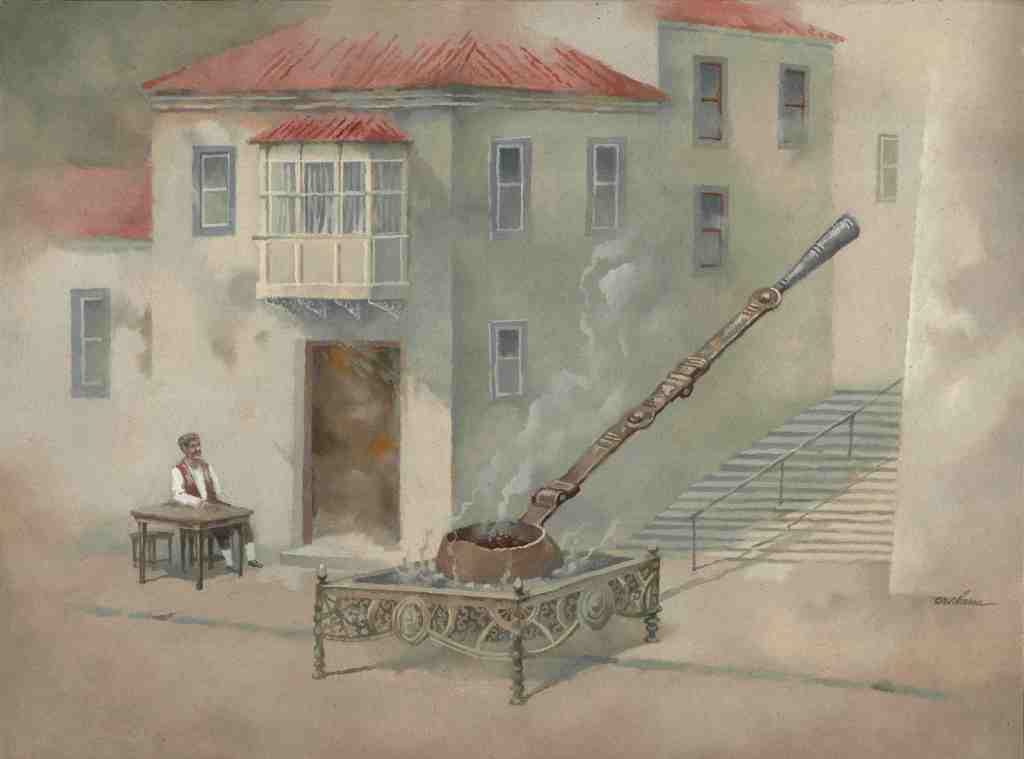
8. Karataş’ta Kahve
Seria Izmir
30 × 40 cm, oil on board, 2026
“Karataş’ta Kahve” evokes one of the everyday gestures that define İzmir’s cultural identity: the preparation of coffee. Florian Doru Crihană focuses his attention on the object that makes it possible. The tray used for roasting coffee beans becomes the nucleus of the composition. The folding handles, designed to facilitate transport, evoke the mobility of caravans and the journey of coffee from the Orient towards the Mediterranean world.
In Crihană’s painting, the tray is visibly enlarged and placed at the centre of the work, transforming a domestic utensil into an urban landmark. Its extended handle establishes a diagonal that leads the eye towards the steps of the Karataş neighbourhood, while the smoke rising from the vessel envelops the landscape. The figure seated at the table on the left introduces a sense of anticipation, while the imaginary square in Karataş becomes a space in which all the elements contribute to the atmosphere. The low houses, sloping streets and the opening towards the Aegean Sea are brought together by the artist in an imaginary landscape constructed from real fragments. The tray, the stove and the smoke become landmarks around which the space and the relationships between people are organised, with coffee representing a ritual of closeness.
9. Karataş’ta Sabah Kahvesi
Izmir Series
40 × 30 cm, oil on board, 2026
One of the city’s quietest moments is captured by the artist in Karataş’ta Sabah Kahvesi: the morning. Drawn to its form, Crihană begins with a traditional coffee grinder. Its wooden body suggests the silhouette of a house, while the platform designed to collect the ground coffee resembles a terrace, becoming the starting point of the composition. In the painting, the object loses its utilitarian dimension and becomes an inhabitable structure. The grinder’s façade integrates naturally into the volumes of the houses of Karataş. The drawer intended for the coffee takes on the appearance of an entrance into this imaginary architecture. Around it, the steep streets, railings and rooftops of the neighbourhood come together in a perspective that echoes the actual configuration of the place.
Reduced to a few silhouettes, the human presence establishes the scale of a city that is still asleep, in a composition in which the artist subtly reverses the relationship between object and architecture. The domestic act of grinding coffee ceases to belong exclusively to the interior of the home and is projected onto the city as a whole, allowing İzmir to take shape through the opening of windows, the descent of steps, the preparation of coffee, encounters with neighbours and the first glances directed towards the sea.


Wonderful…I wish they would also work on the modern face of Izmir 🙂
Dr.Zeki Hozer
zekihozer@hotmail.com
LikeLiked by 1 person