

T e o d o r a T r o f i m o v
Art History graduate, University of Groningen
Master student in Museology and
Curatorship at the University of Bologna
March, 2026
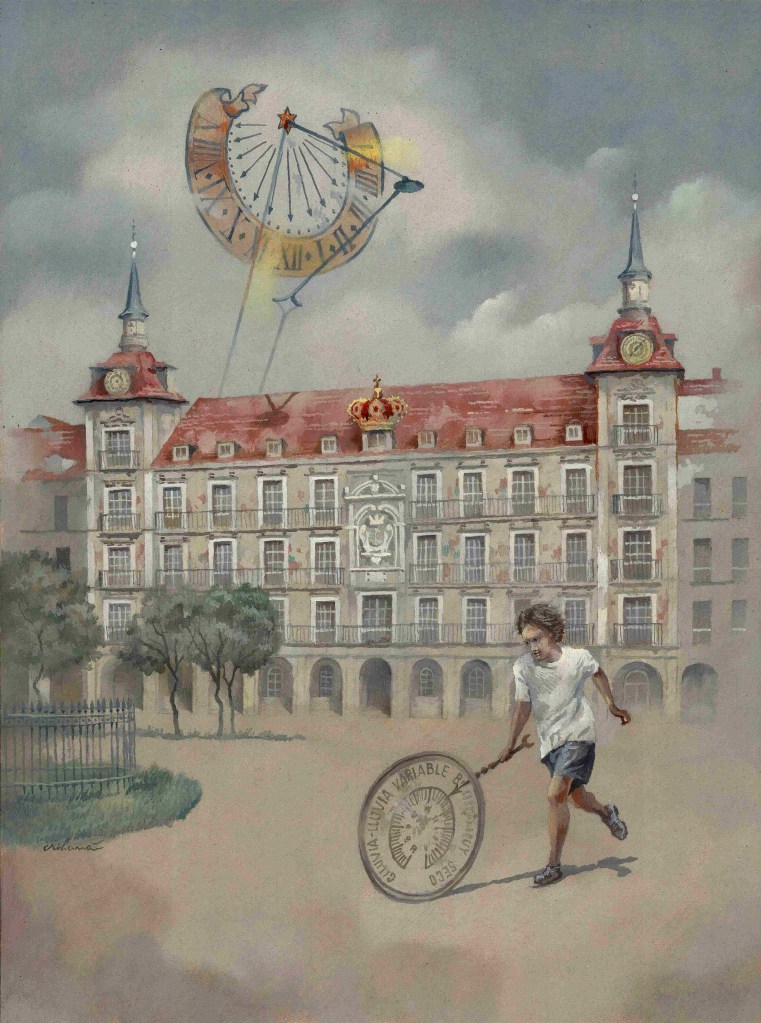
Un Stradivarius en el Palacio Real
A grand, royal staircase, a marble lion which, instead of receiving (or intimidating) his guests, looks over its shoulder and… a gigantic cello diagonally slashing the picture plane; its neck ever so elegantly emerging through the left-side window, while its severed body rests, under the marble gaze of the lion, as if the laws of physics had been suspended. A surrealist scene, which seems serenely balanced in its bizarreness.
There is a certain oneiric atmosphere to Un Stradivarius en el Palacio Real that makes me liken it to a dream that did not vanish upon awakening. Something in the misty, by now recognizable palette of Crihană—muted grays and browns, the subtle white strokes contouring the architectural elements, the light blue peeking through the windows, the velvety burgundy curtains, the vault frescoes merely suggested by sparse brushstrokes—all conjure the hazy contours of a dream, contrasting with the vivid depiction of the immense cello which dominates the palatial abode. Such is Crihană’s surrealism: quiet and gracefully balanced in its peculiarity.
The second painting of the artist’s Madrid series takes us into the baroque Grand Staircase of the Royal Palace of Madrid, designed by architect Francesco Sabatini in the mid-eighteenth century under the reign of King Philip V, whereas the surrealist apparition of the cello points to the Stradivarius quartet of instruments in the Palace’s collection, also known as the Stradivarius Palatin. The beautifully crafted and intricately adorned quartet—comprising two violins, a viola, and a cello—was gifted to the Royal Spanish Household, and the court composer Luigi Boccherini composed over one hundred musical pieces especially for it. Through this unexpected apparition, Crihană links the grandeur of the palace with the musical legacy preserved within its walls.
February, 2026
At a Danube Café, an Artist Prepares for a New Season
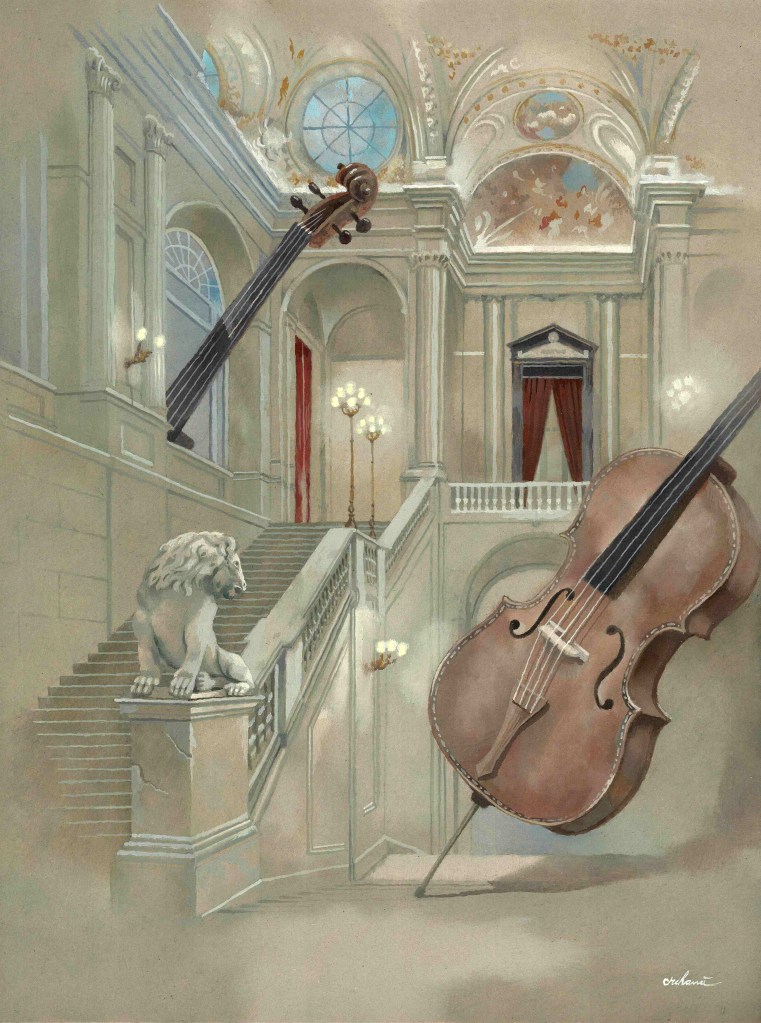
Only seven days part us from spring, yet it feels much further away, as winter tightens its grip with freezing temperatures and snowstorms across Galați and much of Romania. This writer sends her regards from warmer and sunnier places, where spring is slowly but surely taking over. For those not made to thrive in cold weather, daydreaming of warmer days softens the sharp bite of the winter wind. Artist Doru Crihană is no exception, as he impatiently awaits warmer afternoons at his favorite spot in town, a café overlooking the River Danube.
Due to its privileged views of the Danube and Dobrogea’s plains and mountains, the artist’s café of choice is among the liveliest locations in town- an unlikely setting for an oasis of quiet and inspiration, as Crihană calls it. Yet in the six years since he began frequenting this café in search for the elusive ‘spark’ of inspiration that can be hard to find in the confines of a home studio, Crihană has become a familiar presence for the café’s staff and regulars alike. At one of the more secluded tables of the café, many preparatory sketches have taken shape, laying the groundwork for works such as his Barcelona and Lisbon series.
Our shared mental image of an artist at work often entails some chaos, disorder, sudden bursts of inspiration expressed in restless movement. That image does not apply to Crihană. His carefully arranged tools, meticulous notes, and orderly sketches reflect his shipbuilding background and enduring engineering spirit. In the hum of the café, structure and imagination meet, shaping the works that will follow.
February, 2026
Cuesta de la Vega
T e o d o r a T r o f i m o v
Art History graduate, University of Groningen
Master student in Museology and
Curatorship at the University of Bologna
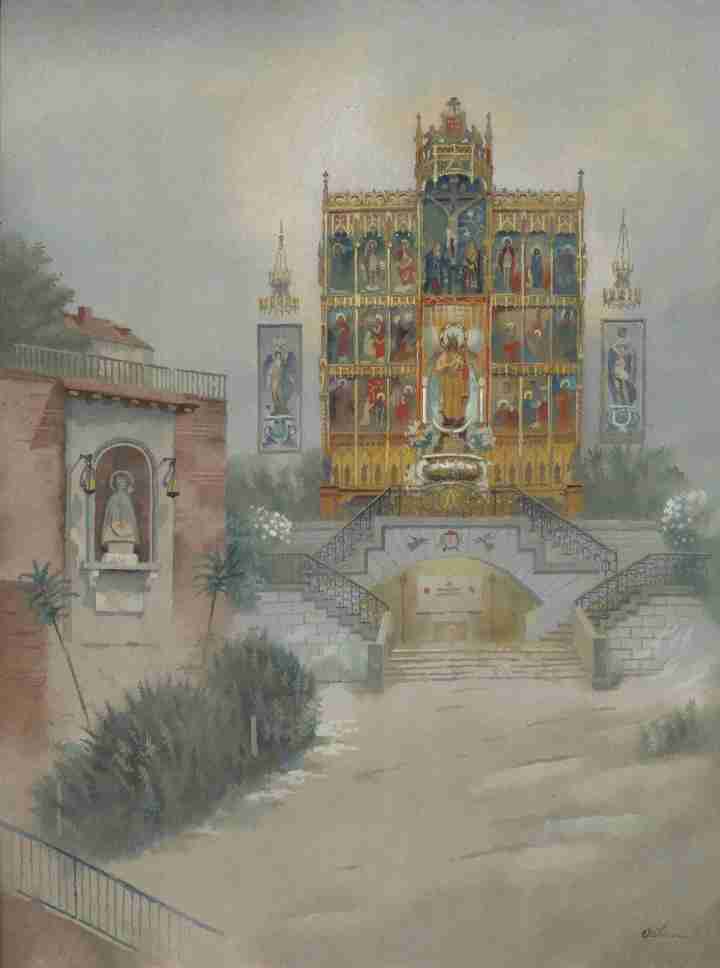
Madrid Series, #1, 40/30cm, oil on cardboard, 2026
With Cuesta de la Vega, Florian Doru Crihana opens his Madrid series on an eerily spiritual note. A palette of colored grays, pale blues, warm ochres, and muted deep greens conjures a space that feels at once tangible and otherworldly. A stone staircase leads downward towards a crypt and upward towards an intricate, gilded altarpiece that seems to be suspended in midair, framed only by shrubs of greenery. To the left of this seemingly weightless structure, two lamps frame a wall niche containing a statue of a saint.
Through these carefully staged architectural elements, the artist subtly invokes the layered history of Madrid and its Almudena Cathedral. The title refers to Cuesta de la Vega, the hill bordering the ravine that once protected the Muslim citadel of Mayrit. Named after the vanished Puerta de la Vega, one of the gates in the Arab wall of the al-mudayna (citadel), the site later became emblematic of the city’s Christian reconquest. The present Almudena Cathedral rises where a medieval mosque once stood, destroyed after Alfonso VI reclaimed Madrid.
The modest niche in the painting recalls the legend of the Virgin of Almudena. According to tradition, a statue of the Virgin Mary was hidden within the city walls before the Muslim conquest and miraculously revealed itself to Alfonso VI after days of prayer, when part of the wall crumbled to expose it. Ever since, she has been venerated as Madrid’s spiritual patroness, her presence woven into the city’s historical and devotional identity. Within the Almudena Cathedral, her richly adorned altar rises in striking contrast to the vast whiteness of the interior—a contrast that finds a poetic counterpart in Crihana’s gilded altarpiece, which appears to hover weightlessly at the top of the staircase, suspended between earth and transcendence.
From Lisbon to Madrid
T e o d o r a T r o f i m o v
Art History graduate, University of Groningen
Master student in Museology and
Curatorship at the University of Bologna
February, 2026
Romanian contemporary artist Florian Doru Crihană is widely known for his painted cityscapes, depicting urban landmarks from his home country—such as Galați and Brăila—to major European destinations including Venice, Potsdam, and Strasbourg, as well as cities beyond the continent, among them New York. The start of the new year marks the unveiling of his 21st thematic series, this time dedicated to Madrid, the capital of Spain.
The Madrid project follows closely on the completion of Crihană’s Lisbon series, finalized toward the end of 2025 and comprising 40 works focused on the Portuguese capital. For the artist, the number is deliberate: forty pieces represent, in his view, the minimum required to fully capture a city’s essence. Each new series begins with an in-depth exploration of the historic core of the chosen city, with particular attention given to its cathedral, often treated as both architectural anchor and symbolic point of departure.
In Madrid, this approach is reflected in the opening work of the series, Cuesta de la Vega, which takes inspiration from the Almudena Cathedral. The cathedral itself is a striking example of eclectic historicism: its exterior is defined by refined Neoclassical lines, its interior by Neo-Gothic grandeur, while the crypt—marked by heavy columns and rounded arches—belongs to a Neo-Romanesque revival. As the conceptual starting point of the series, Cuesta de la Vega signals Crihană’s ongoing interest in cities shaped by layered histories and enduring architectural identities.
 Florian Doru Crihana