

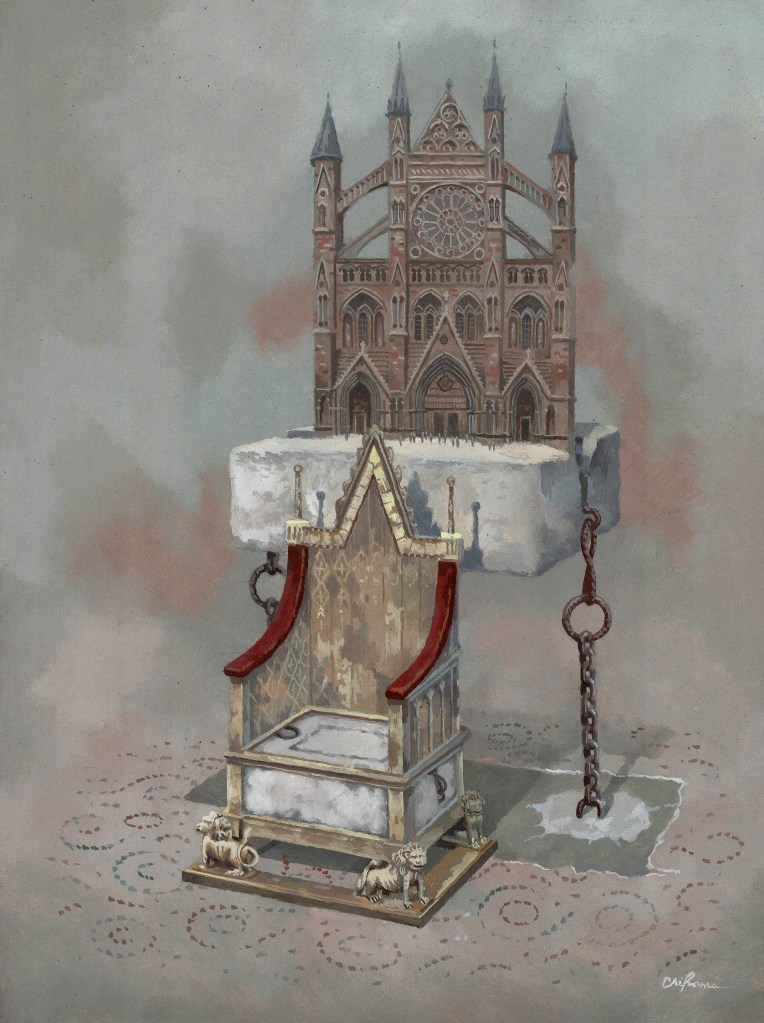
1. Fixing in the Pavement, 40/30cm, oil on cardboard 2022
The throne has played a fundamental role in the coronation of English monarchs and has a long history. Much has been written, films have been made. But in 2010-2012 a thorough study of the seat was carried out and a new understanding of its construction, decoration and relationship with the Scone Stone of Scotland was achieved. Nick Aitchinson proved that the chair and the stone were made together by King Edward I of England. Iron rings were attached to it so that it could be fastened to the floor of the church – an idea of the priest of Westminster Abbey. The king agreed, not wanting to turn the story into a conflict with the church. The chair had become an object of negotiation with the Scots, who believed it to be the old spoils of war. Later the rings were used to transport the stone separately to the coronation site and back. The monarchs sat directly on the stone, but later a wooden tablet was added. In 1950, the stone was stolen by 4 patriots – Scottish students. They were caught by the police on their way to Scotland.
The painting brings these elements together in the composition, and the side facade of Westminster Abbey, the more familiar entrance to the public, has also been added. On the floor you can see the rough way of holding the stone by breaking the mosaic.
Private collection in London, not available for purchase
.
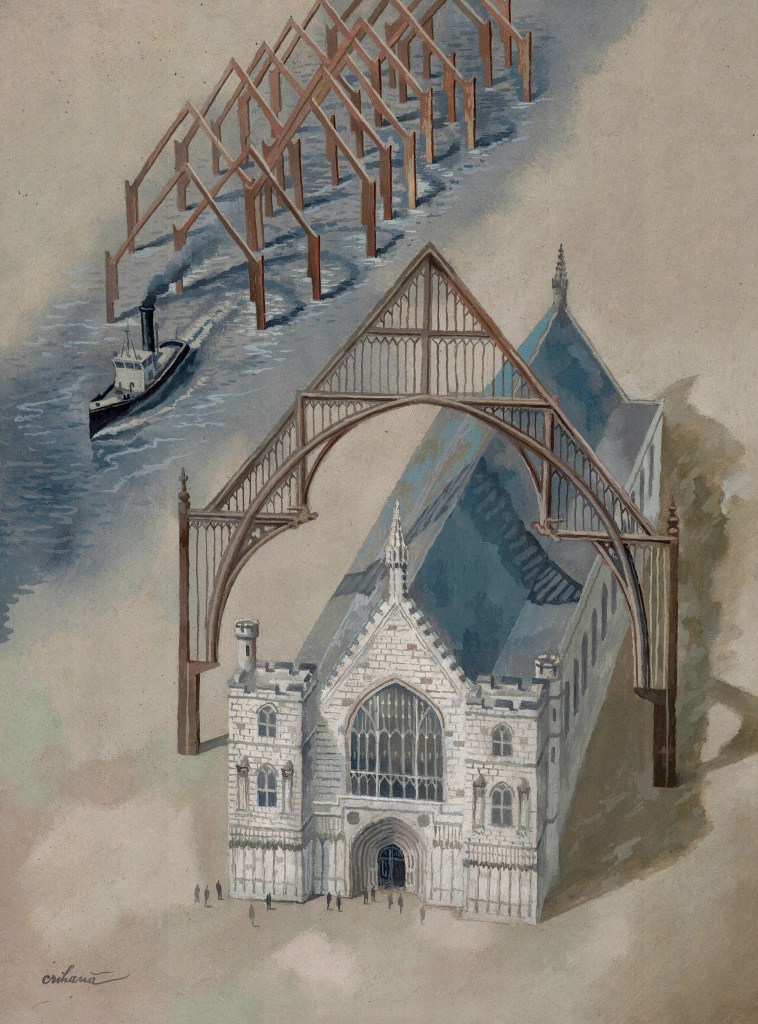
2. Oak Structures Going Up the Thames, 40/30cm, oil on cardboard 2022
The great roof of Westminster Hall is the largest medieval timber roof in Northern Europe. It houses 13 oak hammer beams, weighing around 660 tonnes, which were mostly fabricated off-site and transported to Westminster by barges and horse-drawn wagons for assembly. The work was largely undertaken by the king’s chief mason, Henry Yevele, and carpenter Hugh Herland. Yevele had been involved in almost all the major building projects of the late 14th century, such as the Tower of London, Westminster Abbey and Canterbury Cathedral. He also built the Jewel Tower in 1365-66. To highlight the beam, the artist moved it outside the building.
Private collection in London, not available for purchase
.
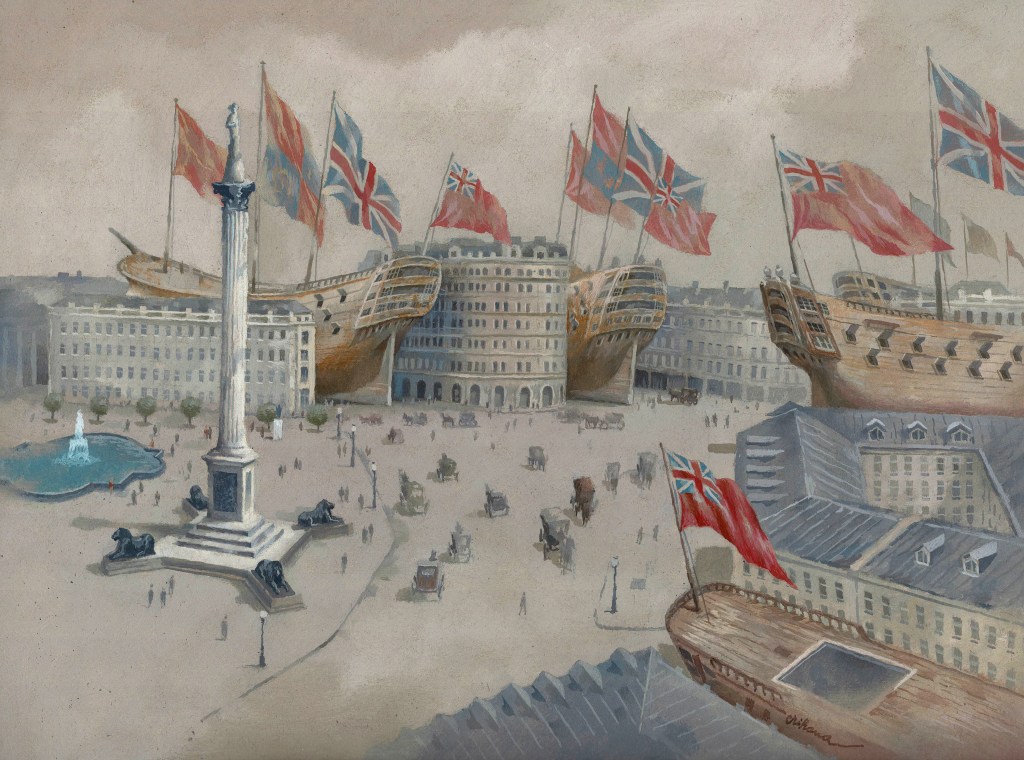
3. Royal Fleet at Trafalgar Square, 30/40cm, oil on cardboard, 2022
Trafalgar Square is a public square in the Westminster area, central London, laid out at the beginning of the 19th century around the area formerly known as Charing Cross. In its center is a tall column bearing a statue of Admiral Nelson, commemorating the victory in the Battle of Trafalgar. Deptford Dockyard was a major shipyard and base at Deptford on the River Thames, operated by the Royal Navy from the 16th to the 19th centuries. It built and maintained warships for 350 years and many significant events and ships were associated with it. With the increase in ship tonnage, the yard moved to Liverpool after the Napoleonic Wars. The Thames was too shallow for these.
In the painting the buildings are arranged on the circumference of the square with distance between them as in reality and as the construction site buildings are built along the banks of the Thames. Placing ships between buildings creates a “romantic” composition with battleships and their commander.
Private collection in London, not available for purchase
.
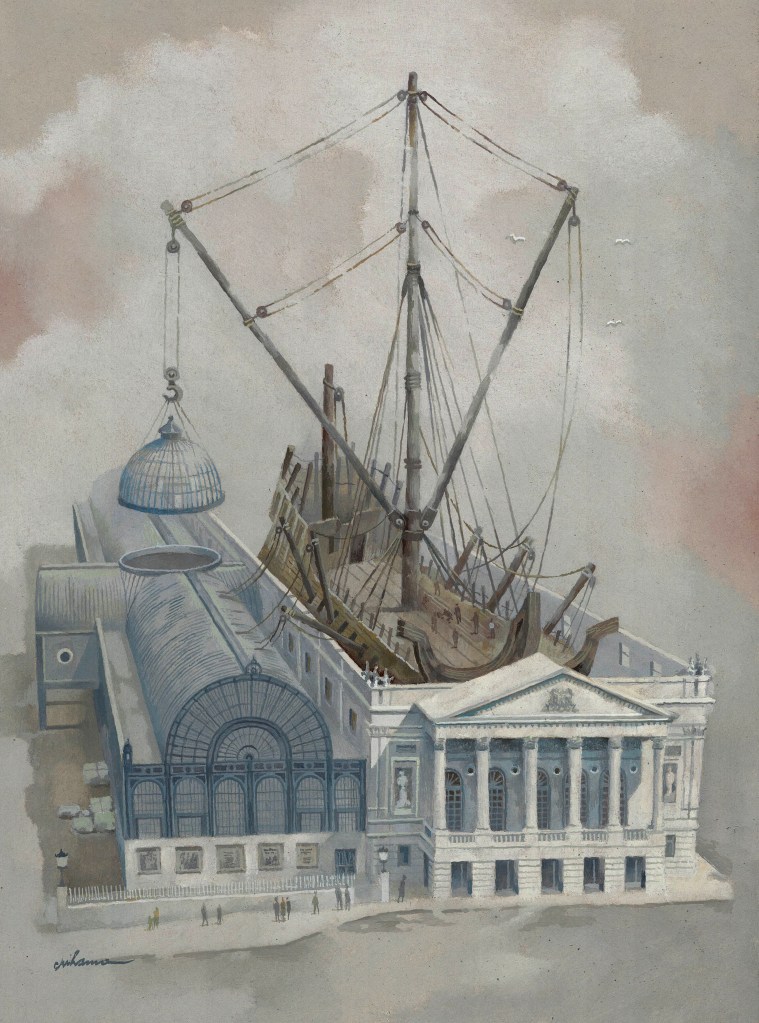
4. The Floating Crane at Covent Garden, 40/30cm, oil on cardboard 2022
The artist saw the shape of the Royal Opera House building as similar to a dock in Deptford Dockyard. As a result, he brought a crane called Sheer Hulk into the space between the side walls. The cranes were obtained by decommissioning decommissioned ships. They were rudimentarily but solidly fitted with a central structure and arms for pulley work. Such refits of old ships were done to obtain barracks, dormitories for workers or penitentiaries. The position of the crane’s mast suggested to the artist the hooking of the dome of Covent Garden. A link was thus created between the two sister buildings. In the painting, an older version of the greenhouse facade is represented, with showcases for show posters.
Private collection in London, not available for purchase
.
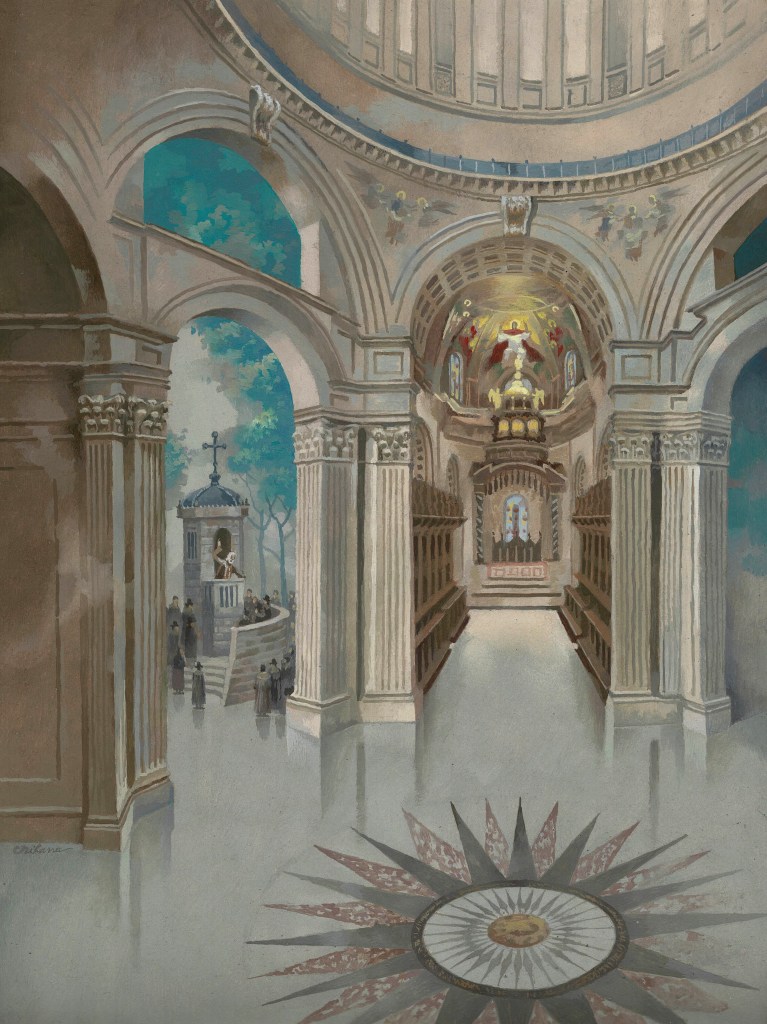
5. The Pulpit of St Paul’s Cathedral, 40/30cm, oil on cardboard, 2023
St Paul’s Cross was an outdoor space and pulpit in the grounds of Old St Paul’s Cathedral in London. It was the most important public pulpit in Tudor and early Stuart England, and many of the most important statements about the political and religious changes brought about by the Reformation were made from here. The pulpit stood in the “court of the Cross,” the open space at the north-east side of St. Paul’s church. At that time, the activity in the church had decreased, even the idea of decommissioning the interior appeared. Many pieces ended up in antique shops. That is why the interior of the church was represented without people. In the painting, the northeast aisle of the cathedral has been suppressed to bring the pulpit closer. Thus the viewer can be led more easily towards the interpretation of the work.
Private collection in London, not available for purchase
.
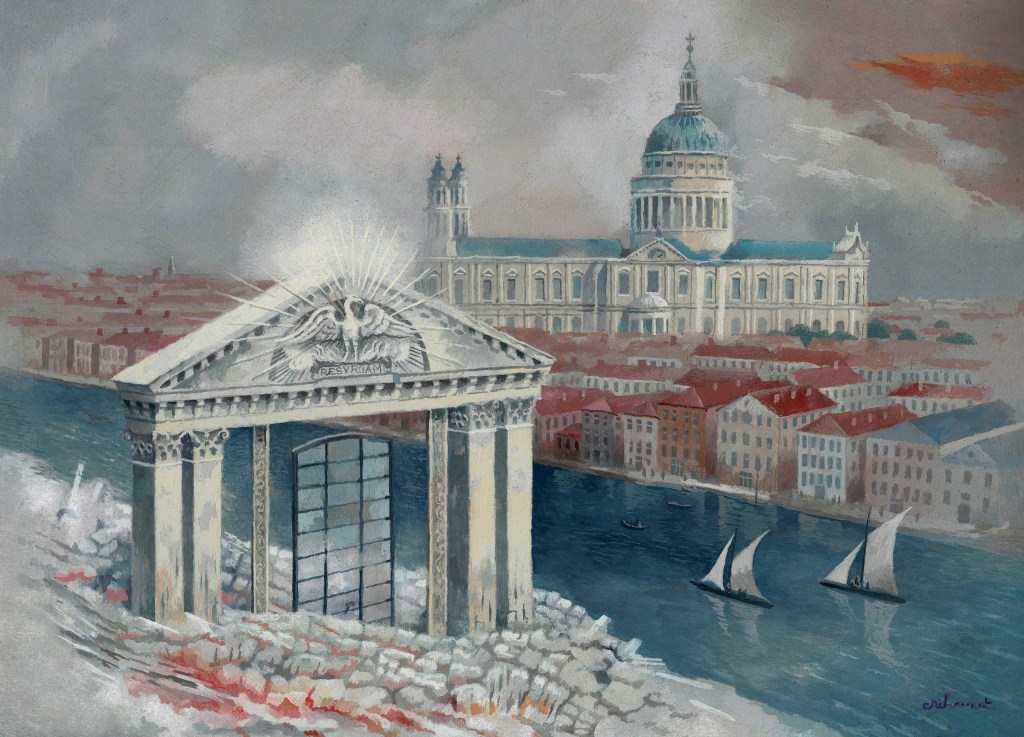
6. Resurgam, 30/40cm, oil on cardboard, 2023
The pediment on the south side of St. Paul’s Cathedral – the entrance area – has a bas-relief entitled Resurgam in the upper center. It is dedicated to the rebirth of the city after the great fire of 1666, rebirth symbolized by the rise of the Phoenix Bird. It is of great importance to the history of London and that is why I wanted to highlight it. I didn’t do this directly on the facade of the cathedral, because that’s where the religious symbols are important – they’re sacred. There is the House of the Lord, the bird is only a guest. I detached the pediment and brought it across the Thames, on an area of ashes and smoldering fire. This is how I was able to illustrate my story.
Private collection in London, not available for purchase
.
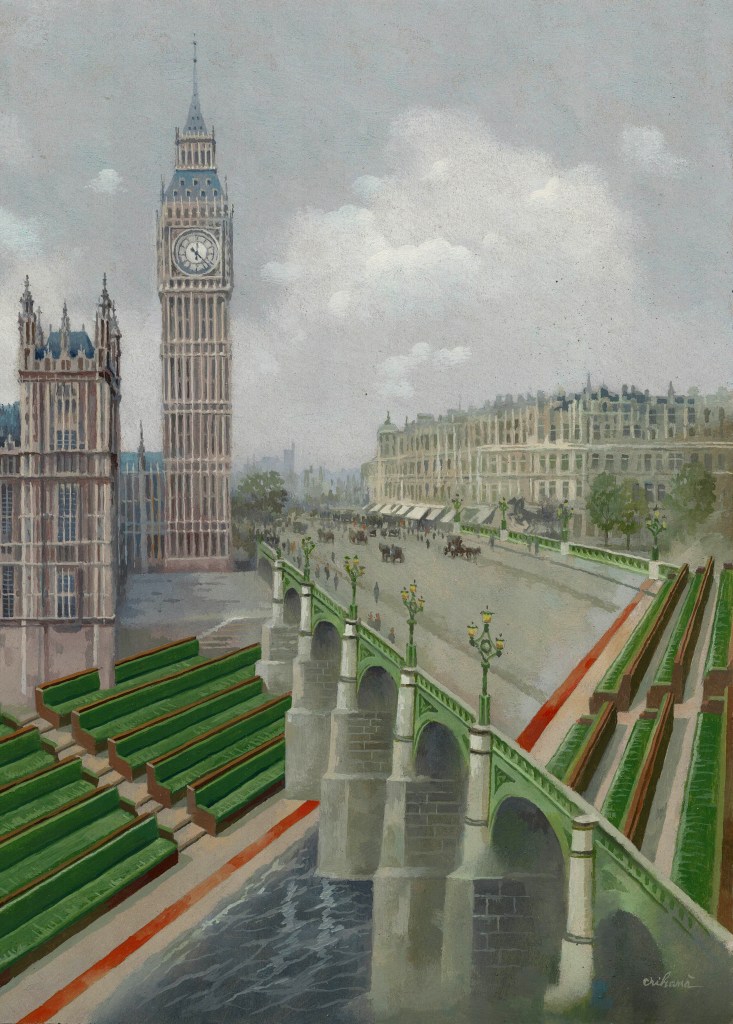
7. House of Commons crossing Westminster Bridge, 40/30cm, oil on cardboard, 2023
The bridge is cast iron and traditionally painted in the color of the leather benches in the House of Commons. I staged these banks down to the water of the Thames. Naturally, I also brought the second section of benches. On the bridge is the Power, under the bridge – the Opposition, which can start “digging”. The bridge is supposed to unite politicians, but it runs diagonally as a zone of separation. Red stripes are drawn in the House of Commons to prevent physical aggression between politicians. The Big Ben tower and a corner body from the monumental Parliament building that stretches along the river also appear in the picture.
Private collection in London, not available for purchase
.
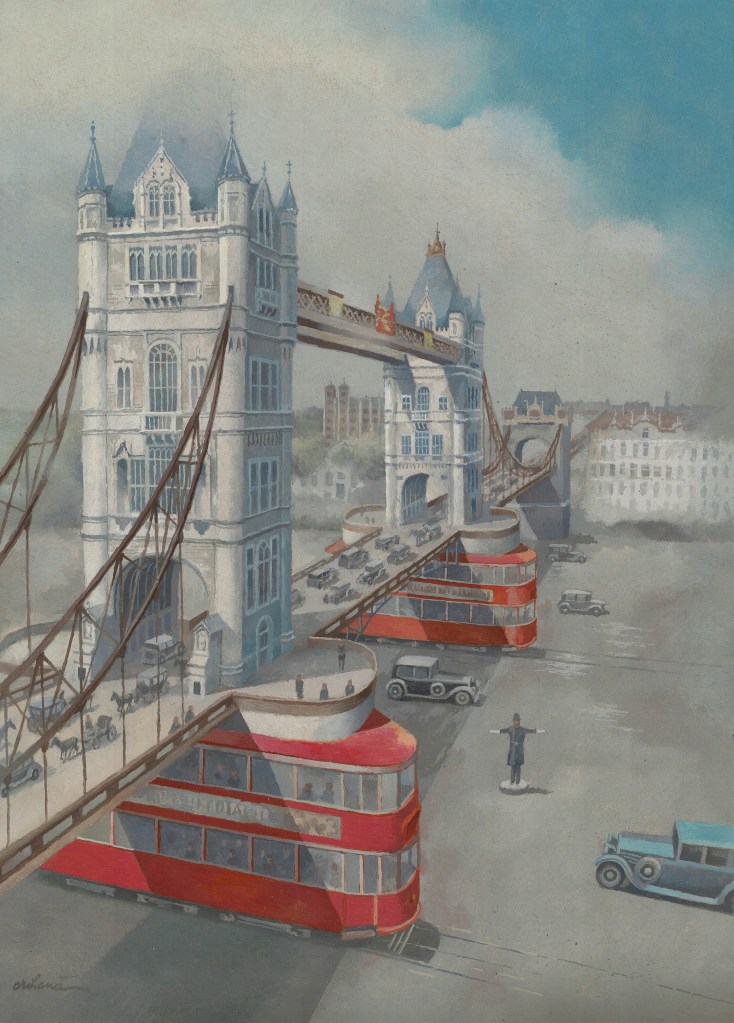
8. Traffic Under the Bridge, 40/30cm, oil on cardboard, 2023
The two foundations of Tower Bridge have a similar geometric shape to the double-decker trams that once ran through London. It was an observation that I used in the finished painting. Thus, a wide thoroughfare was formed under the bridge, in which there is also a policeman from the Road Traffic department. The composition was completed with some vintage cars and even the Tower of London – visible from this angle among the towers. The suspension system of the bridge is colored chocolate-brown, the original color.
Private collection in London, not available for purchase
.
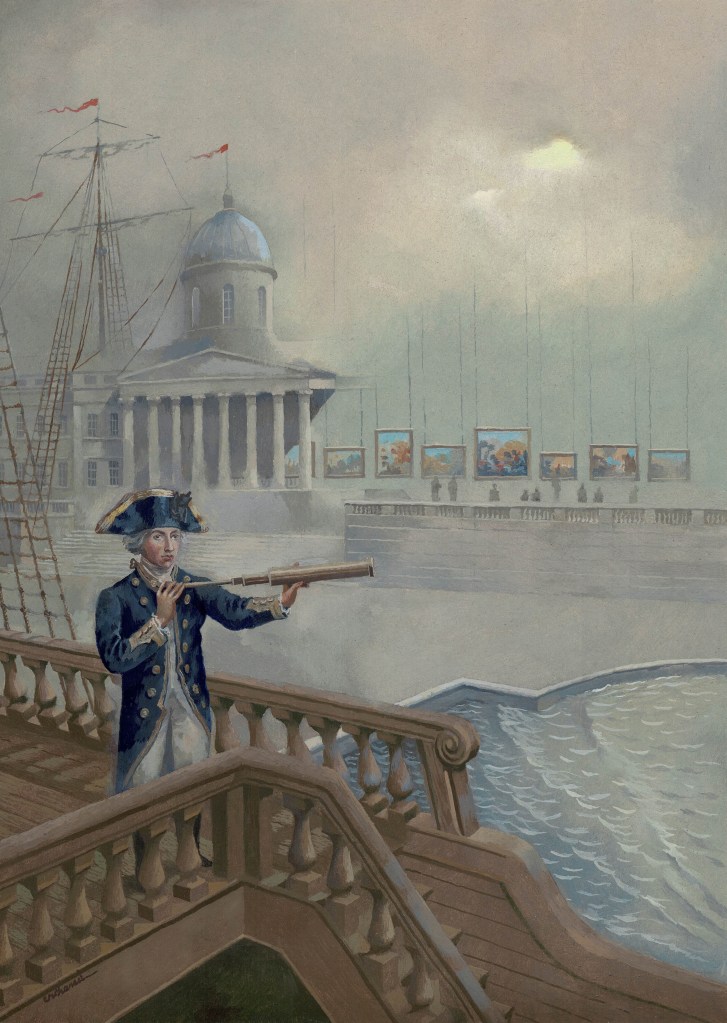
9. Capitain Horatio Nelson at the National Gallery, 40/30cm, oil on cardboard, 2023
Nelson spins on his monument in Trafalgar Square and enters the role of his youth, on a ship. From that position he can admire the famous paintings in the museum – reference exhibits in world art. But the initiators of the museum project wanted the headquarters to be in the center of London, so that even the most needy citizens could have access. That is why, due to lack of space, the building did not take on a monumental aspect, remaining forever in the London fog or being the target of the press, personalities and many ironies. I note that Nelson could not be represented as an admiral as he would not have been able to hold the scope with his right hand – his right arm being lost in a battle in the Canary Islands in 1797.
Private collection in London, not available for purchase
.
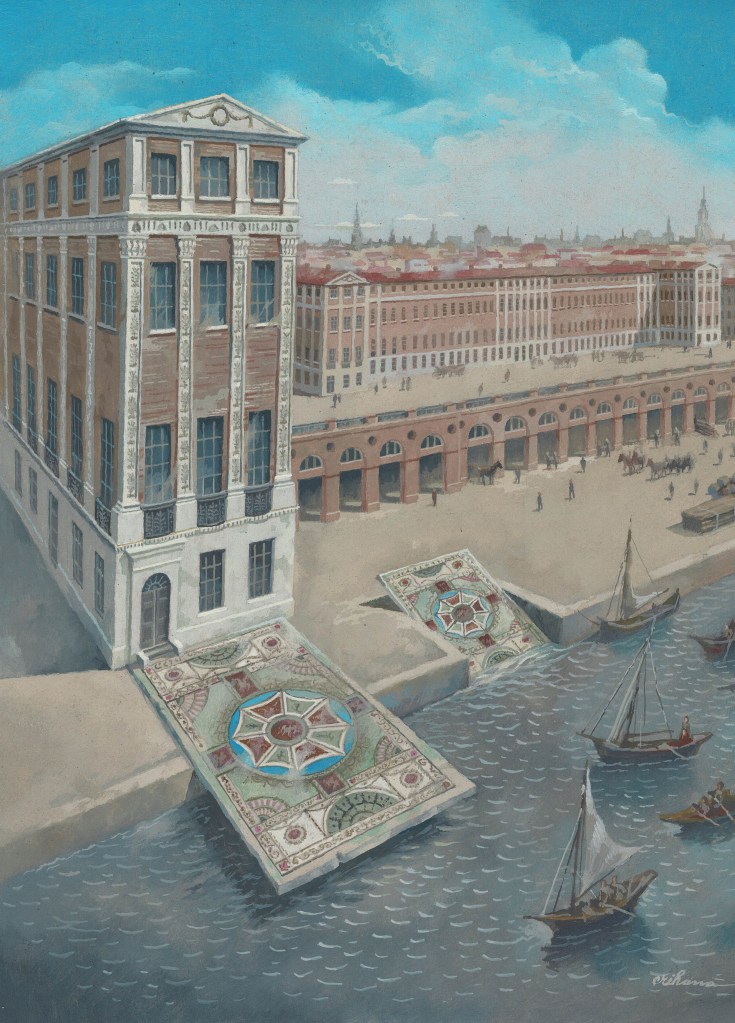
10. Sunny Elegance on the Banks of the Thames, 40/30cm, oil on cardboard, 2023
“Adelphi Terrace” represented a turning point towards modernization and elegance in the architecture of the city of London. The Adam brothers built a series of 24 terraced houses overlooking the River Thames. This platform gave the term “terrace” the meaning of a row of houses. They were built between 1768 and 1772 by the Adam brothers (John and Robert) from Scotland. “Adelphi” comes from the Greek word “adelphos” meaning “brothers”. They chose this name because it represented a very good advertisement. The building was built on the ruins of Durham House – the seat of the Bishop of Durham. Robert Adam designed the building complex, influenced by his extended visit to Diocletian’s Palace in Split, Croatia (formerly Dalmatia).
Adelphi houses were beautifully decorated not only on the outside but also on the inside. In the work you can see an example of the pavement, one of the ones I found in the books – it was probably in the entrance hall. I represented it outside the building so it could be seen.
Private collection in London, not available for purchase
.
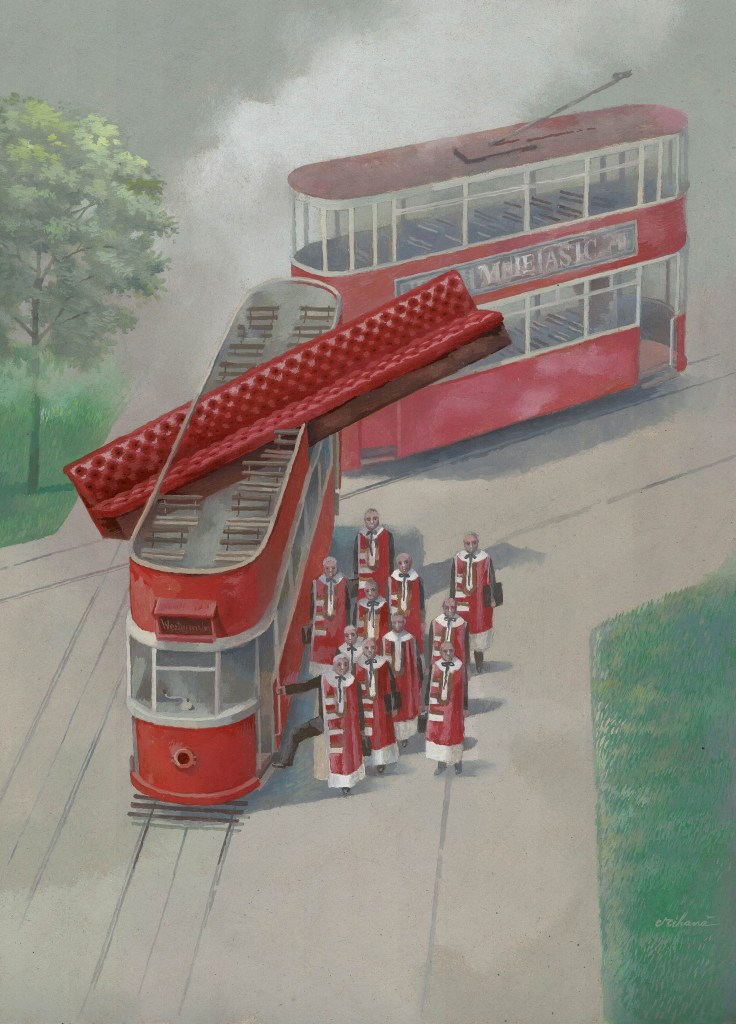
11. Lords at Tram Station, 40/30cm, oil on cardboard, 2023
Private collection in London, not available for purchase
.
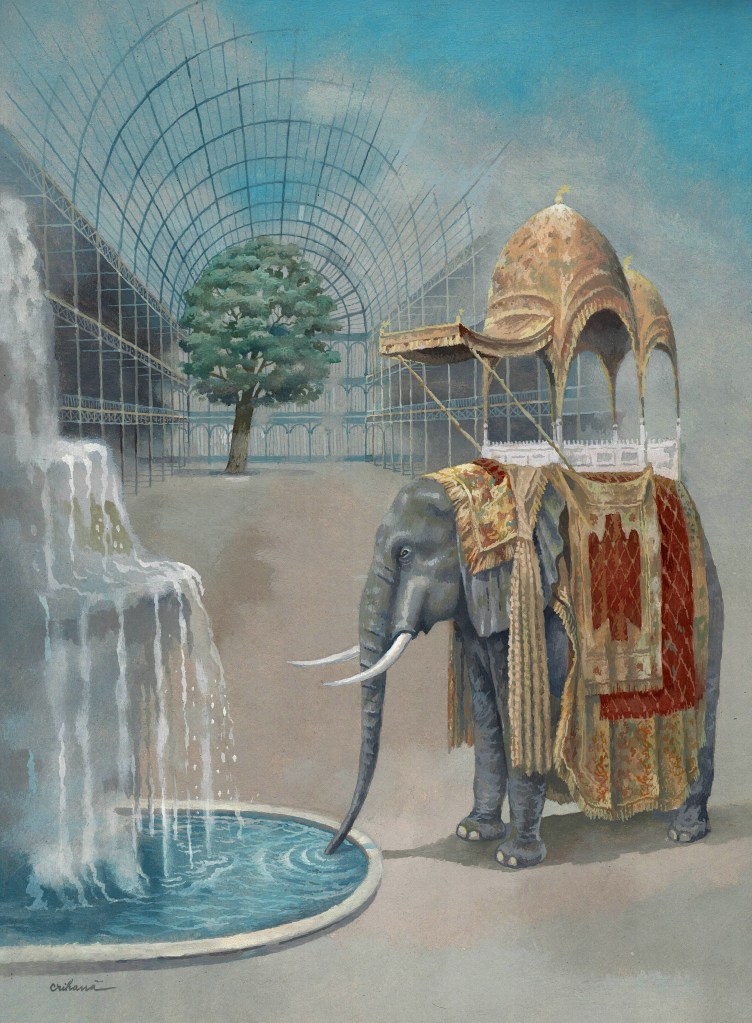
12. An Elephant inside Crystal Palace, 40/30cm, oil on cardboard, 2023
Great International Exhibition London 1851. The gardener Joseph Paxton convinces the organizers with his extraordinary design of the exhibition hall later called “Crystal Palace”. Its name came from an article published in the satirical magazine Punch – “a very crystal palace”. It was entirely glass on a metal frame. Everything was done with a unique window format, 120/25cm strips, avoiding cuts. The Crystal Palace was located in Hyde Park and then moved to Sydenham Hill. It was three times the size of the imposing St. Paul’s Cathedral. During the six months the exhibition lasted, Queen Victoria came 34 times. The painting features an exhibit from the West Indies – enlivened by the artist, served with Thames water. There was a big issue reported by the London press as well. Several elm trees were located in the construction area of the edifice. Joseph Paxton quickly designed the curved roof on the small axis of the palace to avoid cutting down the trees.
Private collection in London, not available for purchase
.
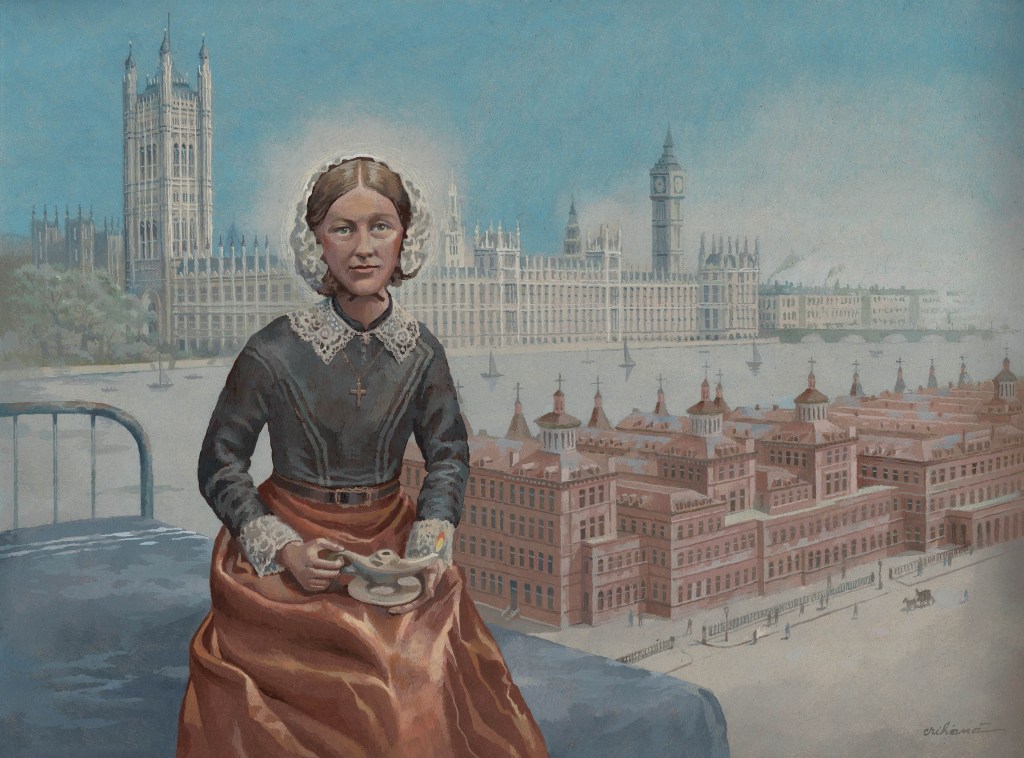
13. Florence Nightingale at St Thomas Hospital, 30/40cm, oil on cardboard, 2023
Private collection in London, not available for purchase
.
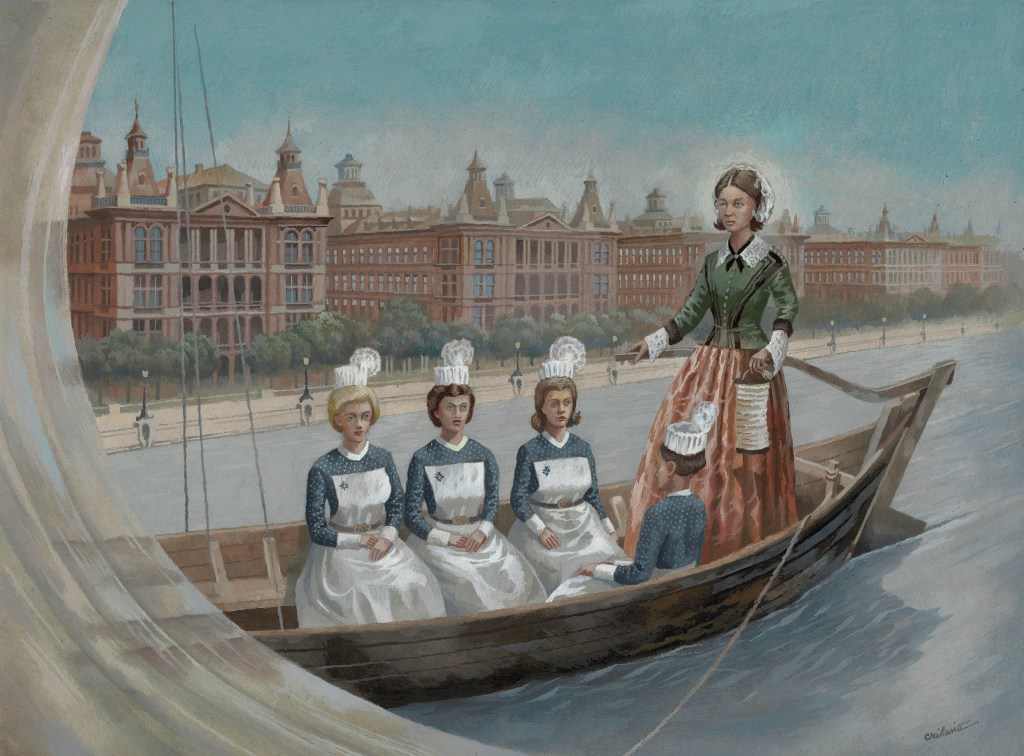
14. The Crew, 40/30cm, oil on cardboard, 2023
Private collection in London, not available for purchase
.
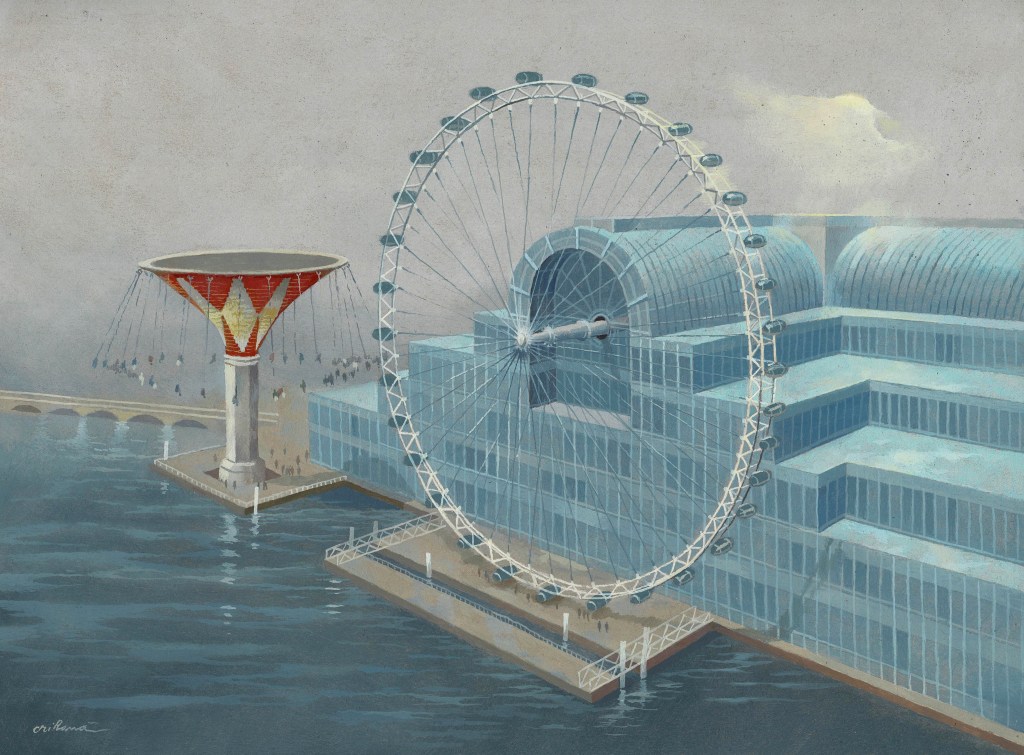
15. The Eye and the Carousel, 30/40cm, oil on cardboard, 2023
Private collection in London, not available for purchase
.
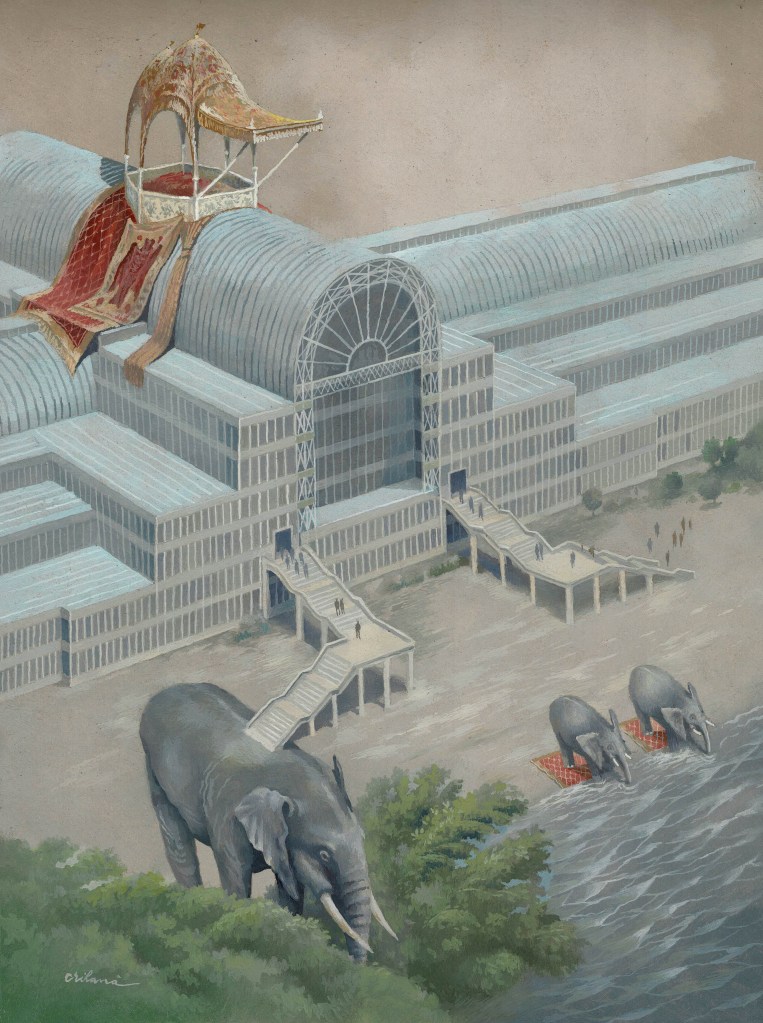
16. A Family at Thames River, 40/30cm, oil on cardboard, 2023
The elephant was purchased and blown from the Grand International Exhibition, London 1851. There it was part of the West Indies booth – it was a buttonhole. The old lithographs executed after the illustration of John McNevin are splendid. McNevin was an American illustrator. My elephant appears in the first painting of the London series inside the Crystal Palace. In that painting, I used the story to show the constructive details of the interior. The new variant represents the second building of the Crystal Palace, that of the Sydenham Hill, which was more imposing than the first. The elephant returned with two children. At the highest point of the palace, elephants parked an incredibly rich Indian-style booth. I used the stage to clearly render the structure of the building seen from the outside, thousands of glass pieces arranged on uniform metal frames.
Private collection in London, not available for purchase
.
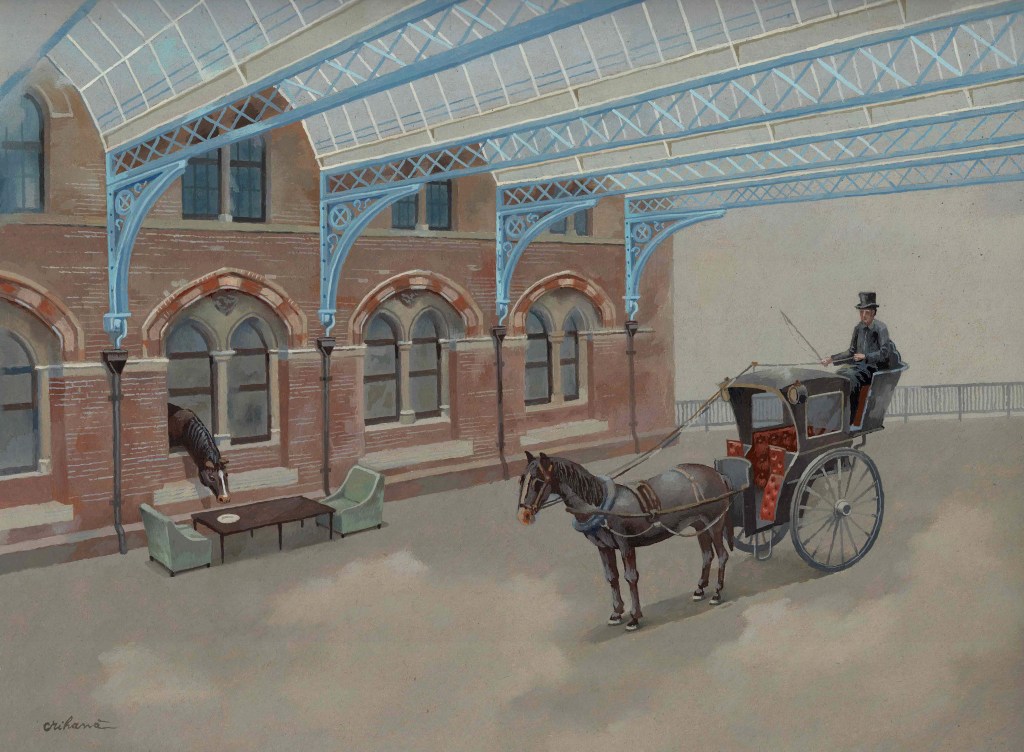
17. St Pancras Lounge and Taxi, 40/30cm, oil on cardboard, 2023
Private collection in London, not available for purchase
.
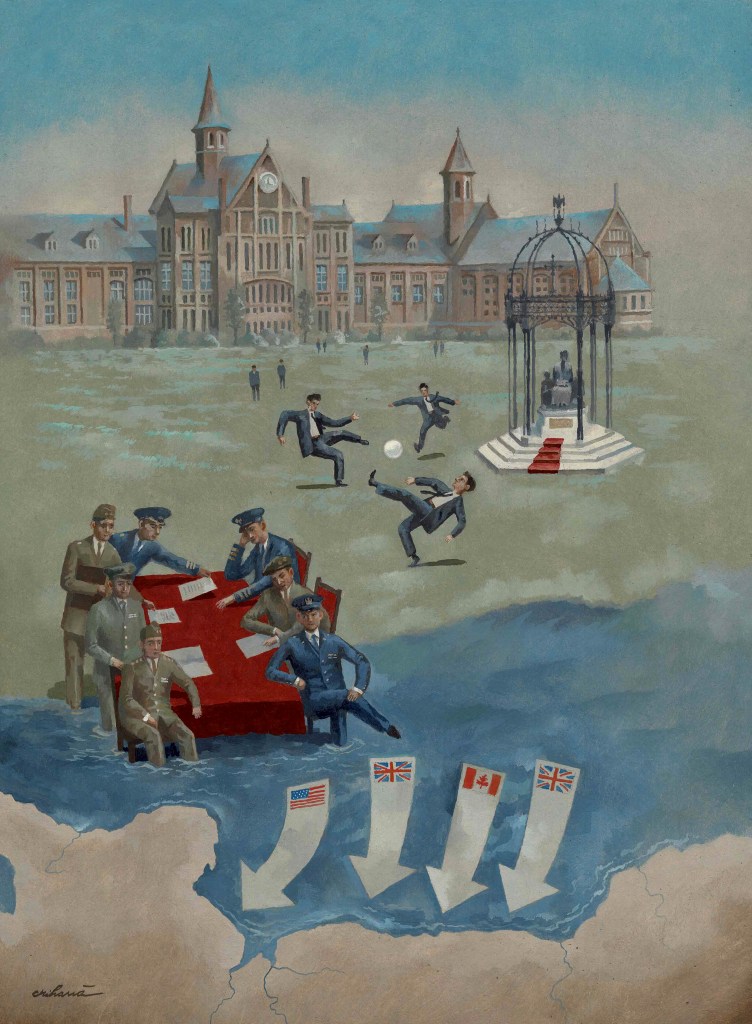
18. D Day at School, 40/30cm, oil on cardboard, 2023
The Great Landings in Normandy. My study of London continued with St Paul’s School, a complex castle-like building – 1509, John Colet(right memorial). I discovered that during World War 2, the school was used by the military. Here the great generals of the Allied Forces drew up the landing plan in Normandy (Air Chief Marshal Sir A. Tedder, General Eisenhower, General B. Montgomery, Lieutenant General Bradley, Admiral Ramsay, Marshal T.L. Mallory, Lieutenant General B. Smith). After the end of the war, the children returned to school.
Private collection in London, not available for purchase
.
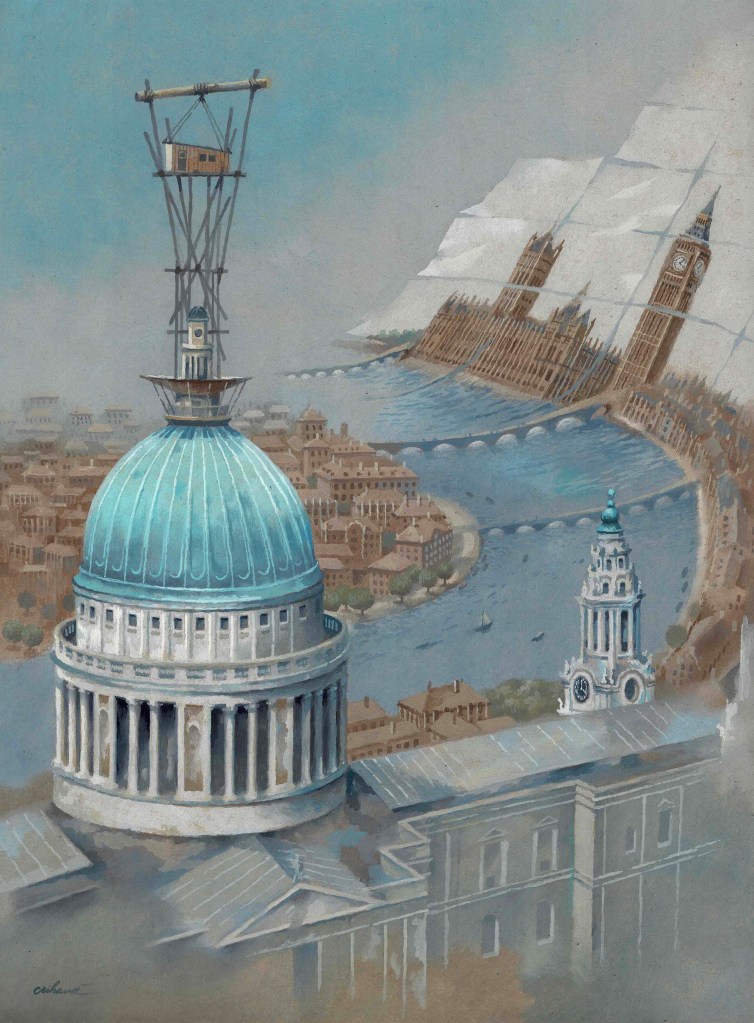
19. Hornor’s Cabin, 40/30cm, oil on cardboard, 2023
In 1821 the artist Thomas Hornor built a temporary cottage on the dome of St Paul’s Cathedral in London. The cross and globe on the dome were in the process of being replaced. He made panoramic drawings with the aim of multiplying and selling them. He didn’t sell anything, but what happened next would be worth evoking in a new painting from me.
Private collection in London, not available for purchase
.
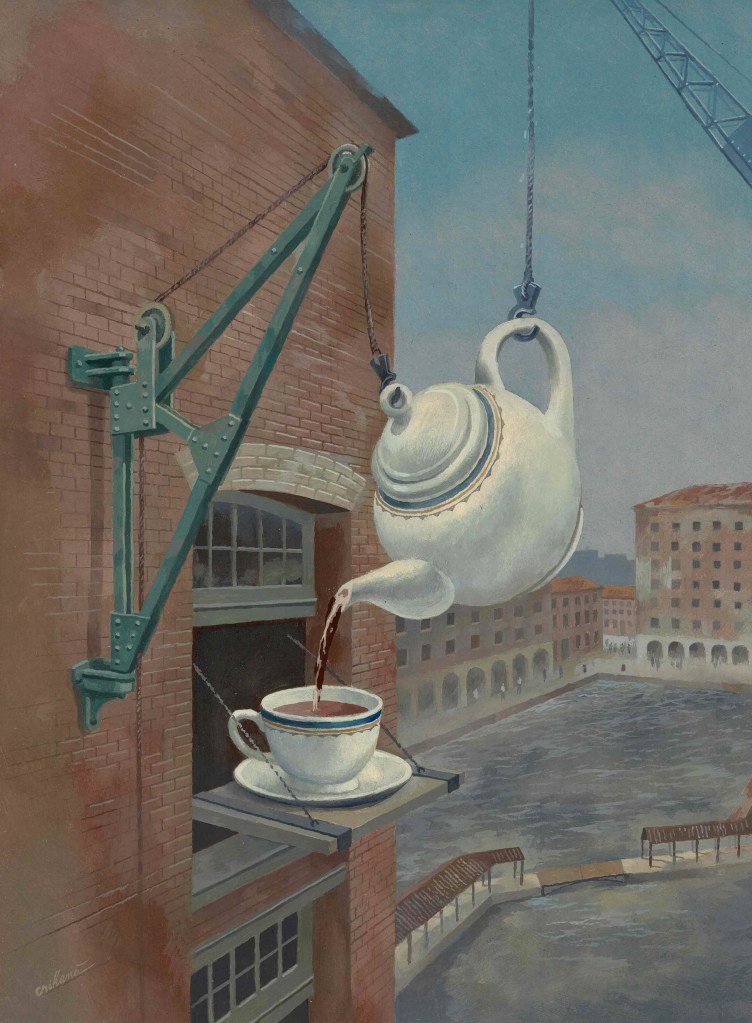
20. St Katharine Docks, 40/30cm, oil on cardboard, 2023
St Catherine’s Docks were built close to the Tower of London Bridge and the Tower of London in Tower Hamlets in 1828. There were two basins with an entrance through the Thames lock. Steam engines kept the water level in these basins constant so as not to disrupt port operations. Thus the activity along the banks of the Thames could stop. Not long after, however, the docks ended up no longer meeting the demands. In 1968 the commercial activity ceased. Today the buildings host luxury homes and the pools – yachts. The few remaining lithographs with this space do not show the work equipment that seems absent. However, with a closer look, you can discover the wall jacks and hydraulic cranes left to this day between the balconies and windows of the apartments. They were not dismantled in order not to weaken the strength of the building. The main cargo transhipped throughout the port’s existence was tea.
Painting available for purchase
 Florian Doru Crihana