
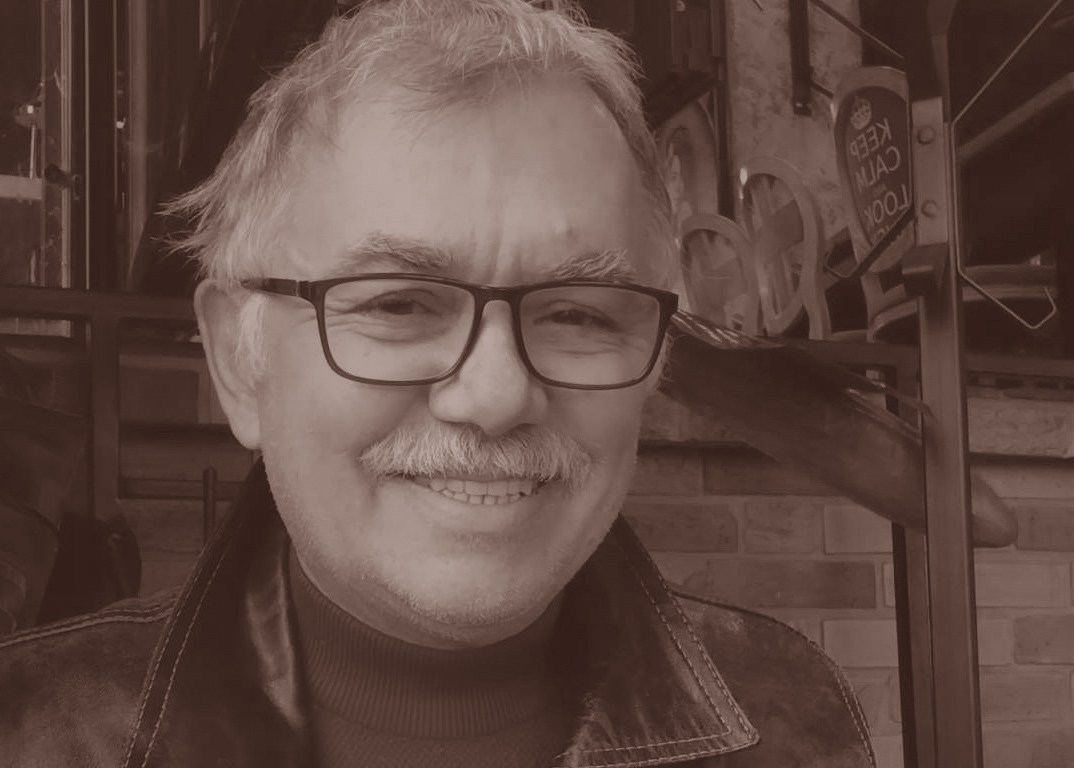
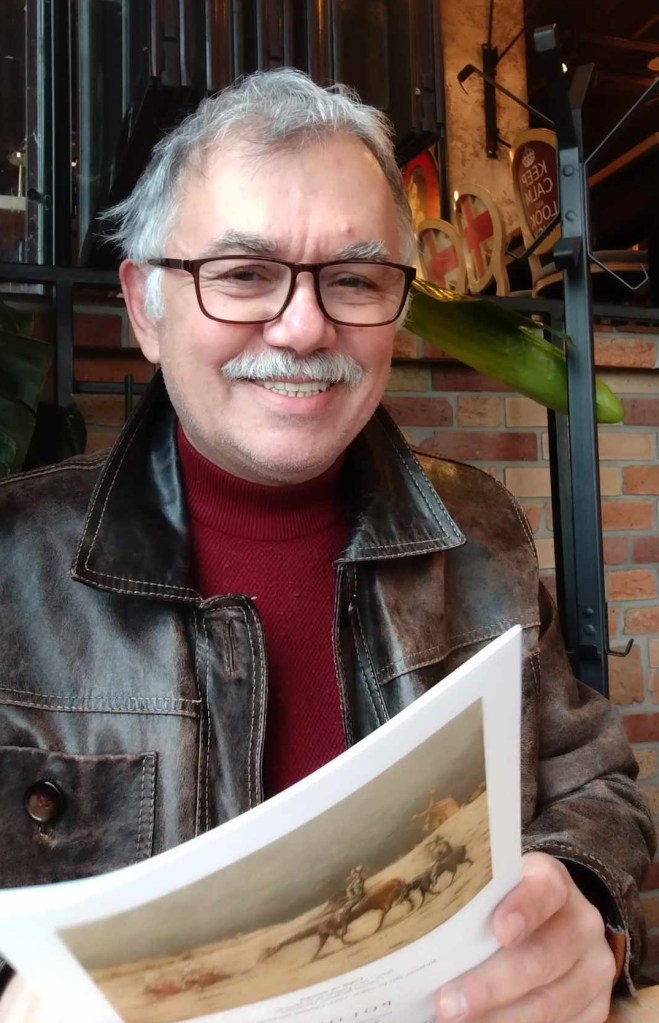
In a cafe at the Danube riverside, a man sits at a sunlit table with his notebook and various pens and pencils before him, nursing his cup of concentrated natural cocoa sweetened with honey. His leather briefcase in the seat beside him, bespectacled Florian Doru Crihana might be an office worker or technocrat enjoying a respite, but closer inspection reveals prolific drawings along with elaborate notes that suggest an imaginative pursuit in this streetside studio. Once a shipbuilding engineer, this urbanite transferred the meticulousness of his studies to the realm of the fantastic, becoming first a successful satirical cartoonist and then a painter of looking-glass worlds that are both admiring and gently mocking commentaries on human aspiration — on our capacity for both grandeur and grandiosity.
It is fitting that Crihana situates himself among the people and the happenings of this lively urban milieu. Not an artist who sequesters himself in an atelier, he draws upon archival materials and available online information about Western cities and Industrial-Age engineering to fashion visual ruminations that have spawned public events and occasionally controversy. Although he has continuously resided in his hometown Galati, Romania, throughout the phases of his personal transitions and his country’s political transformation, Crihana has traveled figuratively through extensive research and in actuality to places beyond its confines. When this country at the eastern edge of Europe was Communist, contact with the outside was closed. Although the freedom of a changed geopolitical landscape allowed him to cross borders, he maintained some of the detached perspective fostered by the divide, creating his cities series using brochures, digital apps, and internet sites, such as Google Satellite, rather than on-site studies. His ability to envision and render complex structures and spaces astonishes local officials, who find it hard to believe that Crihana hasn’t walked their streets.
After choosing a city, Crihana reads about it for a month, compiling a list of important edifices that will be the subjects of his paintings. Over the course of time while working on the project, he amends his selection, as he learns more about the city in the facts, events, legends, and characters associated with its history. In his vignettes, the artist achieves a feeling that the scenes are of another era, even if contemporary elements are included. Characterized by an architectural accuracy and a scrupulous realization, the landmarks and the narrative elements set on this urban stage appear as if viewed through a backwards telescope at a temporal remove.
Composing in his mind three-dimensionally, he draws buildings from different angles, details, and the surroundings, until they become artful and symbolic elements for him to manipulate. Crihana’s fastidious in rendering these man-made marvels is paired with various surrealist strategies at odds with the hyperlogic that created them. Although building and technologies are depicted to scale, the artist willfully plays with scale within his compositions in setting oversized figures and objects as actors within a scene. The artworks are small enough for Crihana to easily carry around Europe on his journeys, and the small dimensions lend a miniaturized quality to his painted fictions. Through recognition and detail, the viewer understands the great size of the buildings and monuments, and containing them within paintings that can be held in the palm of one’s hand imparts a sense of wizardry. The compact size of the paintings in relation to the scope of imagery requires the viewer to draw closer, which sets up a relationship of peering into rather than looking upon, and this makes the viewer a sort of Gulliver examining Lilliput. The introduction of gigantic as well as repeated elements creates a delightful rupture. The artist conjures up surprising elements that also play with the expected proportion and mass of buildings and monuments. Into a recognizable locale, the artist places figures and objects that may be out of context or strangely juxtaposed, which may be cause to see things that have become invisible through familiarity or which may have an associative reference to the site or theme.
Breaking with linear time and playing with rational space, Crihana also goes his own way in his work techniques. Consistent in using the same 30×40 centimeter cardboard material, he paints oil directly on the surface with no preparation but which nonetheless remains stable over time. He has found a cardboard that has the right texture and consistency for his purposes. After extensive research and drawings in preparation, he chooses to paint primarily on one layer, and in this process can’t be wrong. His highwire act isn’t noticeable in the measured sangfroid conveyed. The vividness of his depictions and the boldness of his imaginings is offset yet also intensified by their small size and by the muted tonality of his palette. Even when extending to the edges, the picture seems set into the rectangular shape, so that the precisely mathematical perspective is just as much a comment on the ordering engineering mindset as it vividly creates a world for the viewer to enter.
The low-key colors on a neutral background suggest turn-of-the-last century printing, with the images like those produced for tourists or for promotion. Seeing one of Crihana’s images can feel like getting a postcard from The Great Age of Travel, when modern transportation technologies and systems allowed for speedier times to faraway places. Dressed in late-nineteenth century or early-twentieth-century garb, the middle and upper class townspeople are on display in shared public spaces. There is humor in their decorous demeanor in the midst of spectacle or absurdity. Crihana also includes figures that are representative of the Old World — the other side of the Industrial Revolution — that raises a distinction between past and present, country and city, as well as a distinction of classes; but it is the temperament of Modern Man that is suggested.
The through line for these characters of different periods is their shared architectural heritage, which often includes the imposing religious structures. Growing up in a Communist country, Crihana knew little of the Eastern Orthodox Church or Western Christianity, but the latter offered a means a rebellion against the conformity and dreariness of the state system: “We sometimes learned on the radio – forbidden sources – that the Catholic Church was subversive, inciting a new democratic order in Eastern Europe.” Reproducing Orthodox icons for sale, he was introduced to the lives of the saints, and the formal construction of these traditional religious works showed him how repetition and changing size facilitated messaging or gaining the attention of viewers in a hurry.
The cathedrals of Europe became an important subject. When studying cities for his projects, he almost always began with the cathedrals along with the city’s patron saint. These grand churches are as much symbols as they are buildings, embodying a collective energy and sustaining a value structure. The moment that Crihana favors is a cusp in which aspirations were newly invested in iron-and-steel constructions that are monuments of industry and capital — when people put faith into technology. The 1889 Exposition Universelle hallmark Eiffel Tower, the once tallest building in the world now-demolished Singer Tower, or the doomed ocean liner Titanic became the new cathedral. A century or more later, this moment in human history seems somewhat quaint, as optimism has been tempered by a cultural cynicism approaching dystopianism by what Western civilization has come to. Yet when asked what he believes in, the artist offers “the communion of people’s positive thoughts,” and his art-making is not an exercise in nostalgia but a sort of tincture that crystalizes and activates those thoughts.
Seduced by the exquisite replication and enchanting artistic invention, we may not be aware of the risky subjects Crihana has tackled. While his beautiful illustrations are fanciful, exhibitions of his work have provoked feelings just below the surface of local inhabitants, bringing history into the present: “I am a creator of dialogues with the public on their most important issues, often recognized as a mediator of local conflicts, in their city.” For example, in Legnica, Poland, his series of paintings were embraced by the authorities, honored with a catalog, a postcard, a calendar, a huge poster but criticized by a part of the locals as actually being a tribute to the German rule over the city. In Potsdam, Germany, the issue was discrimination against former citizens of the German Democratic Republic. People had the opportunity to express their feelings calmly in front of the work and their Romanian guest, with discussions continuing well after Crihana returned home.
Keeping a copy of Don Quixote on his nightstand, Albert Einstein pushed the boundaries of science, influenced by a number of literary and philosophical sources. “Logic will get you from Point A to Point B. Imagination will take you everywhere,” the man associated with the theory of relativity asserted. This certainly has been the case for our artist sitting at the cafe in Galati. In a number of paintings, Crihana features the 17th-century Spanish literary character Don Quixote and the 20th-century Austrian physicist. Both raise questions about the nature of reality, and both the author Cervantes and his admirer disrupted the given precepts of their discipline in a way that shifted thinking about how the world is stitched together. Space and time are loosened from any moorings, and we inhabit a mutable psychic world of our making. What we believe to be true often holds sway over what is true. Puncturing the illusion of a rational, implicit order, Crihana the engineer-turned artist — with a twinkle in his eye — builds upon his quantitative skills to express the subjective, emotional, non-linear forces that shape our reality, and his engaging art snaps us out of blind acceptance of how things are.
Stephanie Grilli, PhD
Denver, Colorado – United States
 Florian Doru Crihana
Thanks, Stefanie! Thanks Philadelphia!
LikeLike